A vacuum pump decides how low the pressure can go; a vacuum gauge decides whether you know where it actually is. No single sensor reads honestly from one atmosphere down to a millionth of a millionth: each family works on a different physical trick with its own limits. This article walks through every gauge family you will actually meet, from the dial Bourdon gauge to the residual gas analyzer, explains how each one works, and shows how to match one to your range. To pin down what vacuum level your work needs, see our article on the vacuum levels of acrylic vacuum chambers.
Table of Contents
- What Does a Vacuum Gauge Actually Measure?
- Mechanical Gauges: Bourdon Dial, Capsule, and Piezo Diaphragm
- The McLeod Gauge: The Absolute Reference
- Thermal Conductivity Gauges: Pirani, Convection-Enhanced, and Thermocouple
- Capacitance Manometers: The Gas-Independent Workhorse
- Ionization Gauges: Hot Cathode and Cold Cathode
- Residual Gas Analyzers: Knowing Which Gas It Is
- The Vacuum Gauge Families at a Glance
- Which Vacuum Gauge Should You Choose for Your System?
- Let Sanatron Spec Your Vacuum Measurement
- Frequently Asked Questions
What Does a Vacuum Gauge Actually Measure?
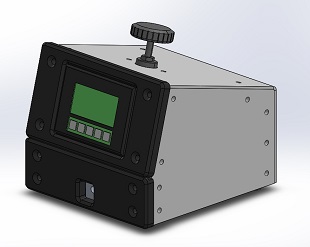
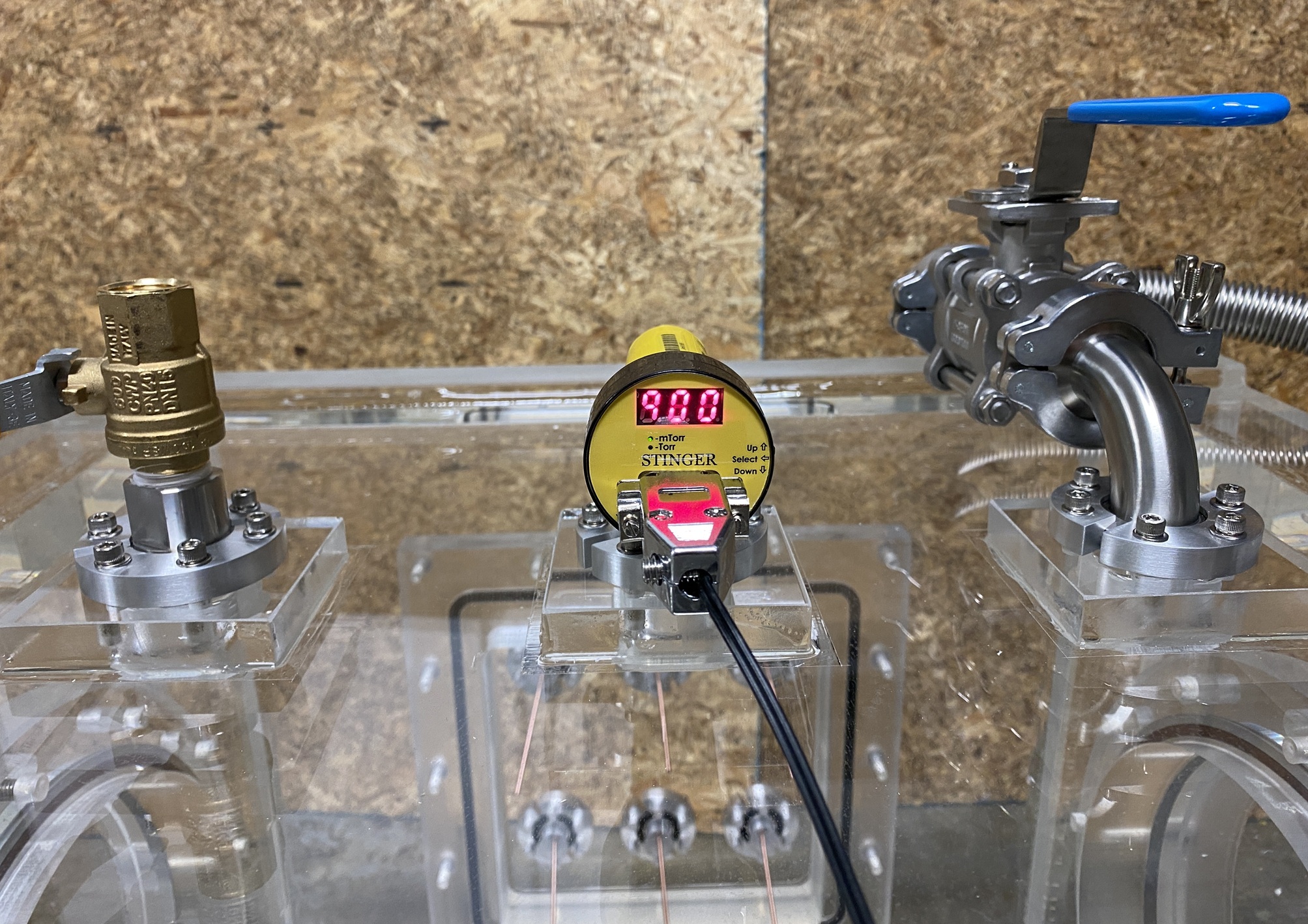
Figure 1. A digital vacuum gauge readout: the sensor converts a physical property of the residual gas into an absolute pressure value the controller displays and logs.
Two ideas explain nearly every gauge decision. First, vacuum is quoted in absolute pressure: a perfect vacuum is a fixed physical zero, not a room-relative one, so a reading of 29.5 inches of mercury of vacuum is really about 11 Torr absolute. And because the scale spans more than ten orders of magnitude, gauge scales are logarithmic and no technology stays honest across all of them.
Second, most gauges are indirect. Instead of feeling the force of the gas on a surface, they convert some property of the residual gas into a signal that shifts with gas composition. Only the direct family, the manometers and the McLeod, reads correctly regardless of which gas is present. That distinction matters in leak-rate work too, covered in our guide to understanding leaks and leak rates.
Mechanical Gauges: Bourdon Dial, Capsule, and Piezo Diaphragm
The oldest family measures force per unit area directly. A Bourdon dial gauge uses a circular-arc tube of elliptical cross section, sealed at one end and linked to a pointer mechanism at the other; evacuation deflects the tube and rotates the pointer. High-precision versions cover roughly 10 to 760 Torr with sensitivity around 0.2 Torr, and like any dial gauge it reads relative to room pressure until it is calibrated as an absolute instrument. The capsule gauge works the same way with a sealed, evacuated diaphragm capsule that expands as pressure drops, read through a lever and pointer; linear scales make it honest to only about 10 mbar and least accurate at the bottom of its range.
The piezoresistive diaphragm gauge is the solid-state version of the same idea: a diaphragm sits over an evacuated reference volume with strain-sensing resistors diffused into it, and the change in resistance as the diaphragm flexes is the pressure signal. These are extremely robust, insensitive to sudden air inrush, and accurate across the rough to medium vacuum range, from over one atmosphere down to roughly the milliTorr region.
The McLeod Gauge: The Absolute Reference
The McLeod gauge, developed by H.G. McLeod in 1874, is a compression manometer: it traps a known volume of gas, compresses it by a fixed ratio that can reach 100,000 to 1, and reads the amplified pressure against a mercury column, so the reading is a true absolute measurement of permanent gases, reliable from about 10-1 down to 10-4 Torr. Its calibration is unaffected by gas type, which is exactly why McLeods were historically used to calibrate every other gauge. The tradeoffs are severe: it reads intermittently rather than continuously, and any condensable vapor in the sample liquefies during compression and disappears from the reading. It is rarely used in plant work today, but it remains the standard against which the others were judged.
Thermal Conductivity Gauges: Pirani, Convection-Enhanced, and Thermocouple
Thermal conductivity gauges are the rough-vacuum workhorses. A Pirani gauge runs constant current through a fine heated filament; once gas is present, conduction through that gas dominates the heat balance, so the filament's temperature and resistance change with pressure and that change is calibrated against it. Both families top out around a Torr, because above that point conduction stops changing with pressure. Their shared weakness: thermal conductivity varies widely between gases, so readings drift by a factor of five or more in a gas other than the calibration gas, and oil vapor plated on the filament shifts the calibration for good.
The thermocouple gauge solves the same problem from the other side: a thermocouple spot-welded to the heater element converts the filament's temperature directly into a voltage through the Seebeck effect, covering roughly 75 Torr down to a few tenths of a milliTorr. Rugged, inexpensive, and available pre-oxidized for stability in dirty service, it is good enough when all you need is to know you have a rough vacuum. Convection-enhanced Pirani gauges break the one-Torr ceiling: once the gas can circulate freely, the convective flow past the heated element becomes the pressure signal, and the usable range stretches to atmospheric pressure and slightly beyond. Because that effect depends on gas physically rising past the sensor, orientation matters: mount the tube with its major axis horizontal above 1 Torr; below 1 Torr it may sit in any position.
Capacitance Manometers: The Gas-Independent Workhorse
When the number has to be right, engineers reach for a capacitance manometer. A thin diaphragm inside the sensor forms one plate of a capacitor; gas pressure flexes it, the capacitance against fixed electrodes changes, and the electronics convert that change into an absolute pressure reading. Because the measurement is a direct mechanical response to force per unit area, it reads correctly whether the chamber holds nitrogen, argon, or solvent vapor, and typical sensors reach from the 10-4 Torr region to over an atmosphere. It is, for all practical purposes, the only gas-independent absolute gauge designed for pressures below 1 mbar. One caution: it measures total pressure only. It tells you that gas is present, never which gas.
Ionization Gauges: Hot Cathode and Cold Cathode
Below the reach of thermal gauges the gas is too thin to measure by heat flow, so ionization gauges count the gas itself. In a hot-cathode gauge, usually a Bayard-Alpert design, a red-hot filament sprays electrons across the gauge volume; they ionize the gas molecules they strike, and the ion current collected at a central electrode is proportional to pressure, honest from roughly 10-3 Torr down to 10-10 Torr. These are the accurate, sensitive instruments of high and ultra-high vacuum work. The cold-cathode family, Penning and inverted-magnetron gauges, uses a magnetic field to spin electrons into long spiral paths that ionize gas with no filament at all: the least expensive high-vacuum instrument, tolerant of sudden air admissions that would kill a hot-cathode filament, but accurate only to about half-value low in its range. Both read honestly only when clean, so the controller keeps the ionization gauge off until the chamber is well below the rough-vacuum gauge's limit.
Residual Gas Analyzers: Knowing Which Gas It Is
A residual gas analyzer is a small quadrupole mass spectrometer bolted to the chamber. It ionizes the residual gas, filters the ions by mass-to-charge ratio, and counts them species by species, so instead of one total pressure it reports which gases are present and in what partial pressure. RGAs work below about 10-4 mbar, so they always ride along behind the chamber's main gauges, and they are calibrated against a known partial pressure before their numbers mean anything. When you need to know whether the chamber is leaking air, boiling off water, or breathing pump oil, the RGA is the only gauge that answers that question at all.
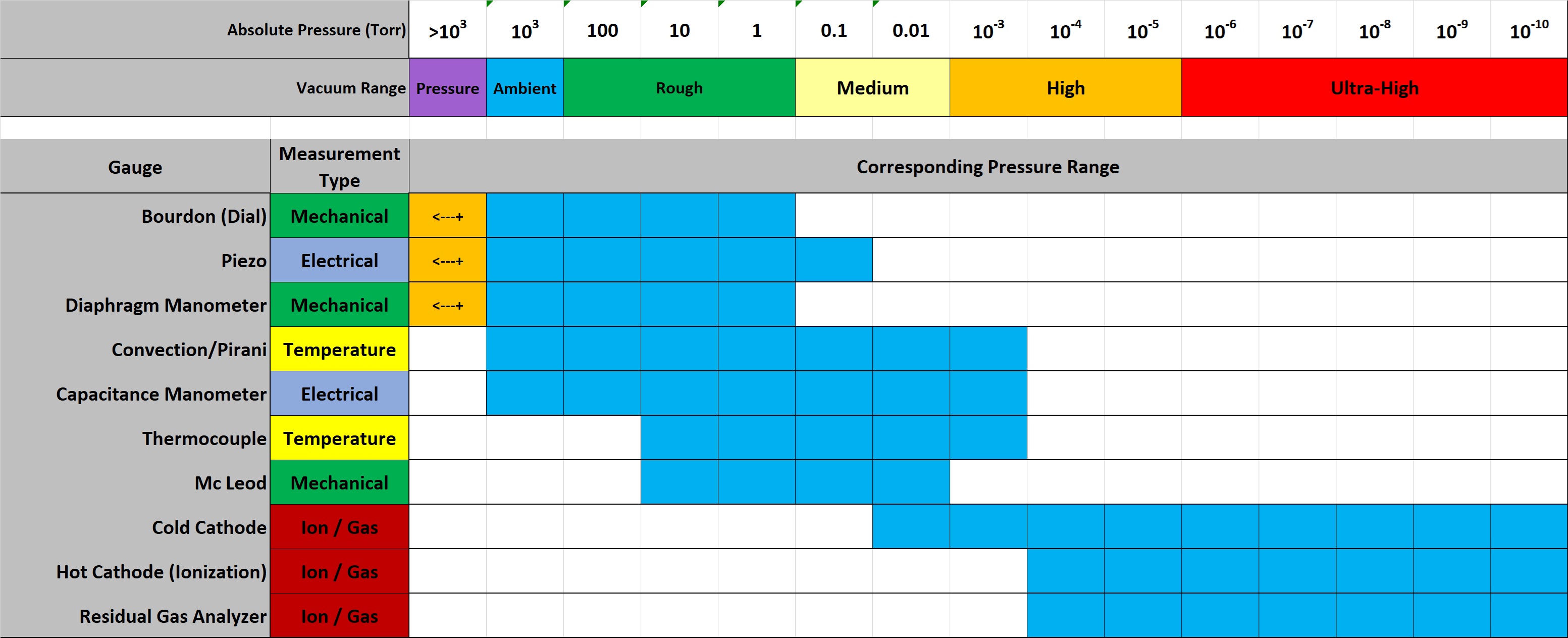
Vacuum Gauge Range Graph
The Vacuum Gauge Families at a Glance
Side by side, the tradeoffs between the families are easy to compare:
| Gauge family | What it senses | Typical range | Gas dependent? | Strengths and tradeoffs |
|---|---|---|---|---|
| Bourdon dial | Deflection of an elliptical sealed tube moves a pointer | Rough vacuum, about 10 to 760 Torr | No, force per area | Simple and cheap; coarse, linear, reads relative until calibrated absolute |
| Capsule and piezo diaphragm | Diaphragm flex over a reference volume; strain or resistance readout | Rough to medium vacuum, atmosphere down to milliTorr | No, force per area | Robust and immune to air inrush; linear scale, weakest at the low end |
| McLeod compression gauge | Traps and compresses a known gas volume to an absolute reading | About 10-1 down to 10-4 Torr | No, but only permanent gases count | The absolute reference that calibrates the rest; intermittent and archaic |
| Pirani and convection-enhanced Pirani | Gas conduction and convection cooling a hot filament | Rough vacuum, Pirani to about 0.001 Torr; convection type up to atmosphere | Yes, a factor of five or more in the wrong gas | Cheap and fast; convection type must sit horizontal above 1 Torr |
| Thermocouple | Seebeck voltage from a thermocouple welded to the heater | Around 75 Torr down to milliTorr | Yes, same thermal limitations | Simple and tough; less sensitive than a Pirani |
| Capacitance manometer | Gas force flexes a diaphragm, changing capacitance | About 10-4 Torr to over one atmosphere | No, reads every gas correctly | The accuracy benchmark below 1 mbar; total pressure only |
| Ionization (hot and cold cathode) | Ion current from electron-impact ionized gas | About 10-3 Torr down to 10-10 Torr | Yes, needs per-gas sensitivity factors | The only family that reaches high and ultra-high vacuum; cold cathode tough, hot cathode accurate and fragile |
| Residual gas analyzer | Quadrupole mass filter sorts ions by mass-to-charge ratio | Works below about 10-4 mbar partial pressure | It identifies each gas by design | Tells you which gas is present, not just how much; qualitative until calibrated |
Which Vacuum Gauge Should You Choose for Your System?
The practical method is short enough to memorize:
- 1. Start from your working absolute pressure, not the pump's ultimate rating, and pick a gauge whose linear range covers it with margin.
- 2. For rough vacuum, use a thermocouple or Pirani-type gauge when you only need an affordable indication, and a capacitance manometer when the actual number matters.
- 3. For high vacuum, choose a hot-cathode ionization gauge for accuracy or a cold-cathode gauge for ruggedness, and always pair it with a rough-vacuum gauge so it is never exposed to atmosphere.
- 4. Overlap your gauges' ranges and set the controller's switch points so exactly one gauge owns every pressure the system will see.
- 5. Mount the sensor close to the work, because pressure gradients inside a pumped chamber are real, and keep convection gauges oriented correctly and away from vapor loads.
On a turnkey system this whole measurement chain, sensor plus digital vacuum gauge and controller, should arrive calibrated and plumbed correctly rather than assembled from mismatched parts at the bench.
Let Sanatron Spec Your Vacuum Measurement
Sanatron has been designing and building custom vacuum chambers and complete vacuum systems since 2008, and gauge selection, sensor placement, and controller calibration are part of every one of them. Tell us the pressure you need to reach and the gas you run, and we will match the chamber, the vacuum pump, and the measurement package to your application. Contact Us and talk to an engineer who has sized both sides of the vacuum equation.
Frequently Asked Questions
What types of vacuum gauges are there?
The practical families are the mechanical gauges (Bourdon tube and capsule diaphragm), the piezoresistive diaphragm gauge, the McLeod compression gauge, the thermal conductivity family (Pirani, convection-enhanced Pirani, and thermocouple), the capacitance manometer, the ionization gauges (hot cathode and cold cathode), and the residual gas analyzer. Each covers a slice of the pressure scale, which is why real systems pair several of them.
Which type of vacuum gauge is the most accurate?
The capacitance manometer is the most accurate general-purpose gauge: it reads absolute pressure directly, as gas force flexing a diaphragm, so it is correct no matter which gas fills the chamber. A McLeod gauge is an even purer absolute reference, but it is intermittent and archaic. Thermal conductivity gauges drift by a factor of five in the wrong gas, and ionization gauges need per-gas sensitivity factors.
Can one vacuum gauge measure from atmosphere to high vacuum?
No. Practical vacuum spans more than ten orders of magnitude, and each gauge technology stays honest over only two or three of those decades. Real systems pair gauges with overlapping ranges and let the controller switch between them.
Do vacuum gauges read absolute pressure or gauge pressure?
Vacuum measurement is essentially always absolute pressure, because a perfect vacuum is a fixed physical zero rather than local atmospheric pressure. That is why 29.5 inches of vacuum is confusing until you convert it: it is roughly 11 Torr absolute. A Bourdon dial gauge is the common exception; it reads gauge pressure relative to the room until it is calibrated as an absolute instrument.
Why does my vacuum gauge reading depend on the type of gas?
Because indirect gauges read a property of the gas instead of a force on a surface. Thermal gauges depend on how well a given gas carries heat off a hot filament, and ionization gauges depend on how readily each molecule ionizes; both change from gas to gas. Direct gauges such as the capacitance manometer and the McLeod do not care which gas is present.
Related Articles:
■ Vacuum Levels of Acrylic Vacuum Chambers
■ Understanding Leaks and Leak Rates for Best Quality Leak Testing
■ Selecting a Proper Vacuum Pump for your Acrylic Vacuum Chamber
Did you know that we carry a many more products?
Our clients prefer to work with us because we are Experts in Custom Fabrication (especially Polymer Fabrication). Check out some of our other items we carry that you can combine/integrate with your systems or projects.