You have chased every joint and fitting with helium. The helium leak test comes back clean. Yet the chamber still refuses to reach its ultimate pressure, and the pumpdown curve flattens out right where you least expect it. Before you tear the system apart looking for a nonexistent hole, consider a different culprit: the virtual leak. A virtual leak is not a breach in your vacuum envelope at all. It is a pocket of gas that was sealed inside the chamber at atmospheric pressure and can only escape through a narrow, high-resistance path, dribbling gas into the chamber slowly enough to imitate a real leak for as long as you are willing to watch it.
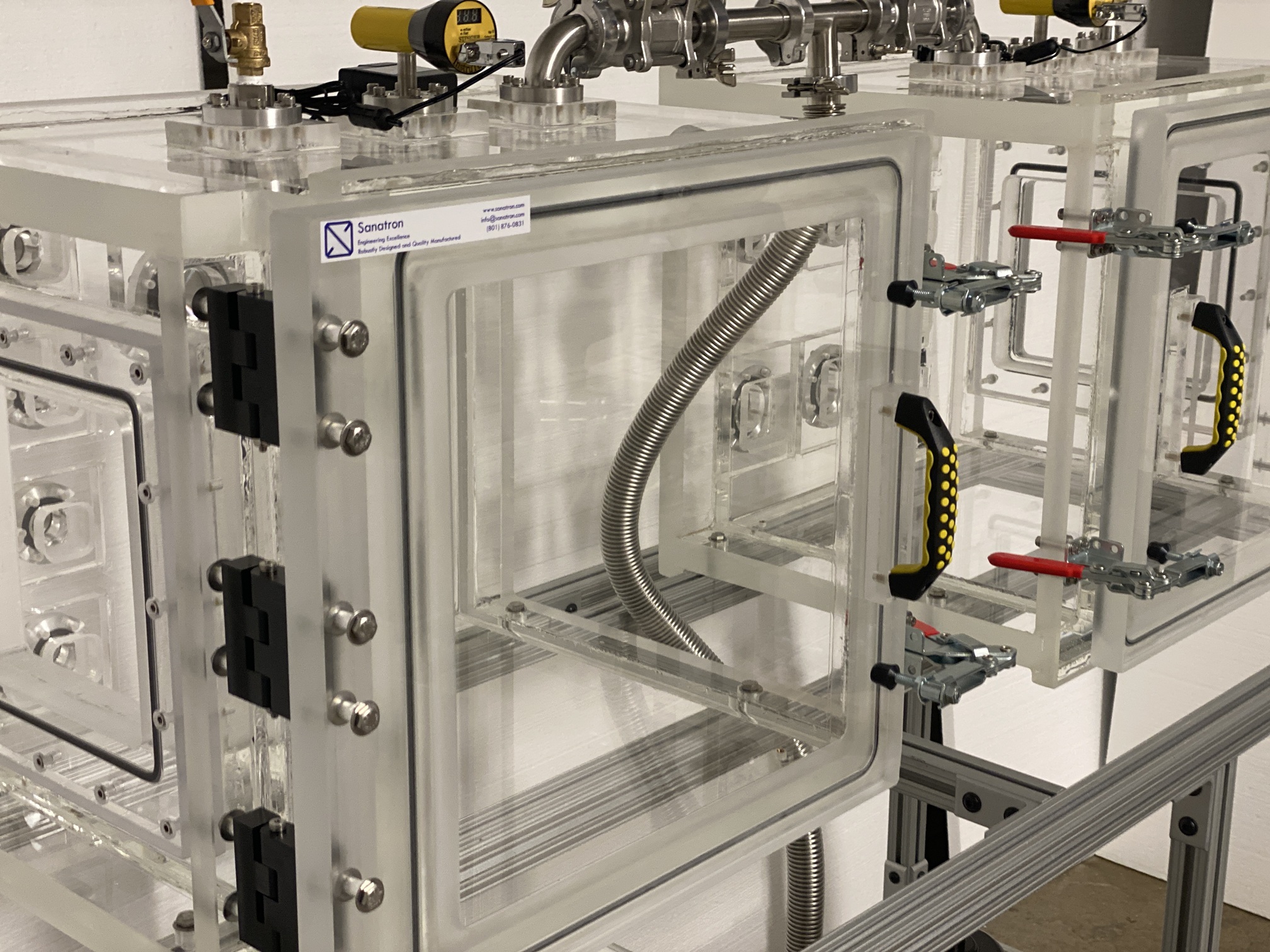
What Exactly Is a Virtual Leak?
Gas does not flow from one place to another when the mean free path keeps growing and the geometry gets tight. The same physics that makes vacuum plumbing resistive is exactly what starves a trapped pocket of an escape route. Picture a blind, tapped hole sealed with a screw: at most, gas can bleed out through the tiny helical maze of the threads. To put real numbers on it, a quarter-inch tapped hole with just a sixteenth of an inch of clearance at the bottom hides roughly 0.05 cubic inches of dead volume. That pocket holds around 0.6 torr-liters of air at atmospheric pressure, and dumping that much gas into a 100-liter chamber amounts to a background on the order of 6 x 10⁻³ torr. That is a substantial, never-ending gas load. In an assembled sputtering cathode, for example, that slowly bleeding air can form insulating oxide and nitride films on the target, which then charge up and arc.
Virtual leaks generally fall into four categories:
1. Gaps between mating surfaces, such as an unsealed lap joint between two flanges
2. Cracks, including hairline weld cracks that dead-end inside a part
3. Surface contacts, like an O-ring seated against a blanked port that walls off a pocket of air
4. Trapped pockets, such as blind tapped holes, machined cavities, and other dead volumes
Trapped air is bad enough, but water vapor is worse. A moisture molecule inside a sealed pocket cannot reach the pump, so it desorbs off one wall and resorbs onto another, over and over, indefinitely. The pocket becomes a permanent secondary outgassing source feeding the very water-vapor load your bakeout was supposed to eliminate.
How to Tell a Virtual Leak from a Real Leak
Virtual leaks announce themselves through the way the system misbehaves rather than through any single reading. When troubleshooting, look for these signatures:
- 1. Repeating pressure bursts. Gas escaping a crack or pocket often arrives in discrete puffs. A digital gauge blinks past too fast to catch it, but an analog gauge held at a steady 1.2 x 10⁻⁵ torr will show repeatable spikes to 1.3 or 1.4 x 10⁻⁵ torr on a roughly fixed time base.
- 2. Thermal sensitivity. Gently warming a suspect area should make the bursts come faster; cooling it should slow them down. This tells you gas is expanding out of a pocket, not leaking through a wall.
- 3. A clean tracer gas test. If sniffing and vacuum accumulation with helium shows nothing while the ultimate pressure stays out of reach, the gas load is almost certainly coming from inside the envelope.
- 4. Gas mixture in bursts. A residual gas analyzer is often unhelpful here, because the bursts are mostly air, and the individual peak changes are too small to see during a total-pressure spike.
Designing Out Virtual Leaks and Fixing Existing Ones
The best virtual leak is the one you never build in. During design and fabrication, the goal is to keep paring away trapped volumes:
- 1. Machine a small relief hole that connects any unavoidable dead volume to the chamber proper.
- 2. Use commercially available screws and bolts with a lengthwise relief hole drilled through the shank so the thread path no longer meters the gas.
- 3. Choose gasket and centering-ring designs with axial venting, so gas between the seal and the ring can be pumped away instead of released all at once as a burst.
- 4. Weld, braze, and assemble carefully. Many virtual leaks are simply sloppy joints and lapped surfaces done without the vacuum application in mind.
Once a system is built and running, retrofit options are limited. Where feasible, modifying or rebuilding demountable components, or drilling relief holes directly into the chamber, applies the same principles after the fact. Where relief is impossible, a practical trick is to backfill the chamber with argon. The pocket will still bleed its inert gas into the chamber and cap your ultimate pressure, but if your process tolerates argon, like many sputtering or controlled-atmosphere processes, the gas load becomes a known, harmless background instead of a mystery.
Let Sanatron Help You Chase Down the Real Problem
At Sanatron we have been designing and building custom acrylic vacuum chambers, vacuum leak testing systems, and complete turnkey vacuum solutions since 2008, and virtual-leak troubleshooting is a routine part of that work. Whether you need a well-vented test chamber engineered so it never develops a trapped volume, help sizing a pump for your vacuum chamber, or a qualified leak test to finally prove the envelope is tight, we can help you get your system behaving predictably again. Contact Us today and talk to a real engineer about your application.