Every leak tester eventually meets a part that shows no bubbles in the tank and no readable failure on a decay tester, yet still loses vacuum in the field. The reason is simple: total-pressure methods have a sensitivity floor, and some production leaks sit well below it. When you need to find or quantify a leak that far down, you switch to a tracer gas. Helium leak testing pairs helium with a mass spectrometer leak detector to find and measure leaks that other methods simply cannot see. This article explains how the method works, why helium is the tracer gas of choice, and how to pick between vacuum mode, sniffing, and accumulation so you can specify the right test the next time a tight spec leaves decay testing behind. For the underlying leak-rate units and flow regimes behind these numbers, see our guide to understanding leaks and leak rates.
Table of Contents
What Is Helium Leak Testing?
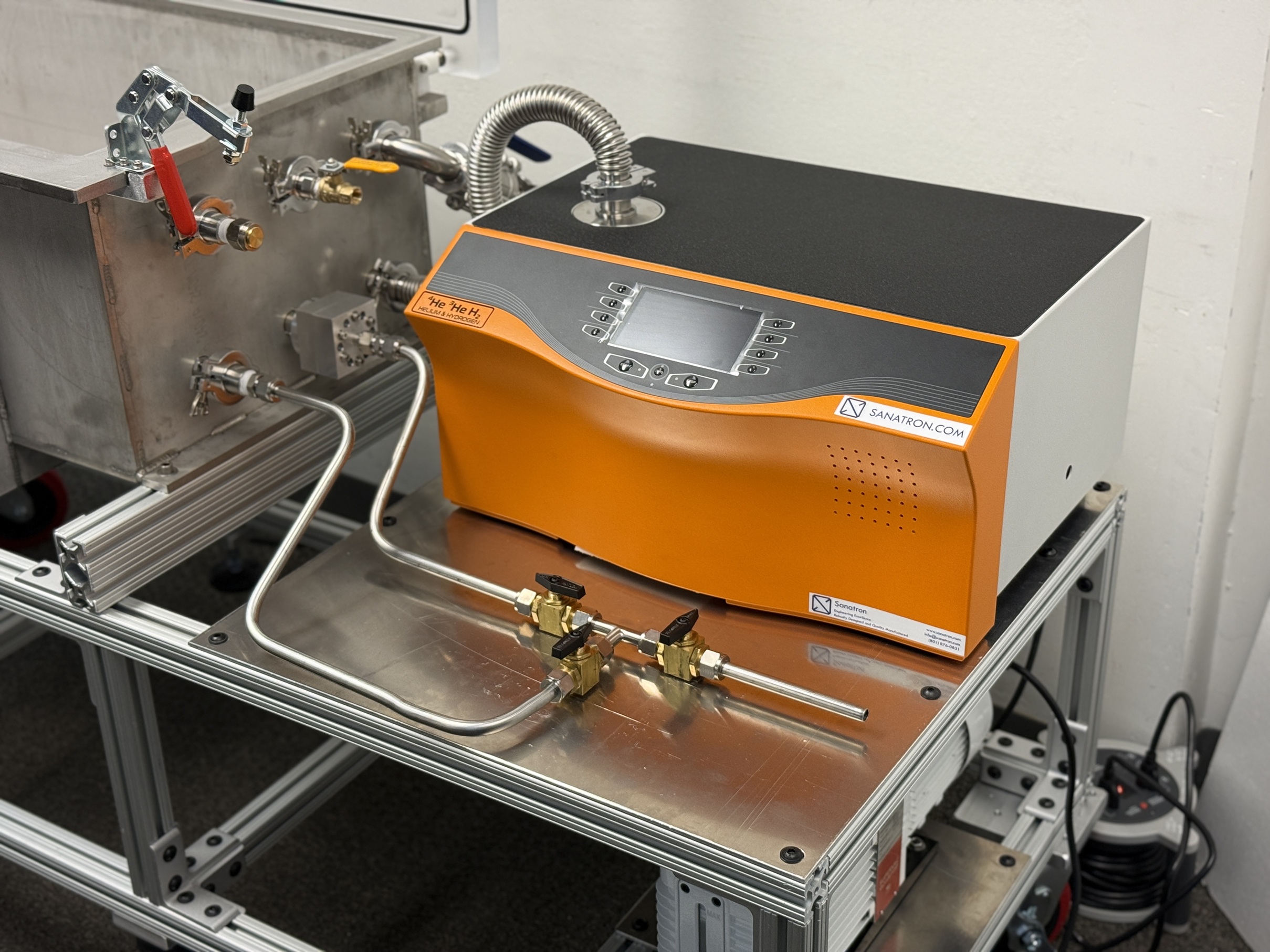
Figure 1. A helium leak testing setup: the mass spectrometer leak detector samples gas from the test fixture and reports the helium leak rate.
A helium mass spectrometer leak detector (MSLD) is really two instruments in one box: a vacuum system and a residual gas analyzer tuned specifically to helium. A turbo-molecular pump, backed by a mechanical pump, holds the analyzer at fine vacuum; a second mechanical pump evacuates the part under test; valves switch between evacuation, test, and venting; and an amplifier and readout convert the ion current at mass 4 into a leak-rate reading. Because the spectrometer counts helium molecules specifically, the signal is unambiguous: helium at mass 4 means helium arrived through a leak path, not that the total pressure happened to drift.
That specificity is what drives the sensitivity. In vacuum integral mode, a modern instrument can resolve leak rates down to roughly 1 x 10-12 mbar l/s, so close to the permeation limit of the materials themselves that it can demonstrate the inherent gas permeability of a solid. Sniffer mode, described below, typically reaches about 1 x 10⁻⁷ mbar l/s. Before any of those numbers mean anything, the instrument must be calibrated against a built-in calibrated test leak, an artificial leak with a known, traceable helium flow, which sets the sensitivity scale before a single reading is trusted.
Why Is Helium the Tracer Gas of Choice for Leak Detection?
In principle, a mass spectrometer can detect any gas as a tracer. In practice helium has become the standard choice for a cluster of practical reasons:
- 1. Helium makes up only about 5 ppm of the atmosphere, so background levels are low and constant, and a rising signal is trustworthy.
- 2. Helium is chemically inert, non-toxic, non-explosive, and approved as an additive for food and pharmaceutical applications, so it is safe for operators and non-destructive to the part.
- 3. The helium atom is very small and monatomic, so it passes readily through the finest leaks and reaches the detector quickly.
- 4. Detection at mass 4 is absolutely unambiguous, and the gas itself is economical and easy to store and handle.
One caution comes from that same small-atom behavior. Because helium moves through tiny paths so easily, it slowly permeates through many plastics and elastomers, which is why permeation, a mass transport through a material rather than a hole in it, can masquerade as a leak on other instruments. Hydrogen can be substituted as a tracer gas at a cost advantage, but with limited sensitivity and flammability concerns, so helium remains the default for the lowest detection limits on the market.
How Is a Helium Leak Test Performed?
Before starting, a good technician answers four questions about the workpiece: is it vacuum-proof, is it overpressure-proof, is the total leak rate to be determined, or only the location of the leak? The answers select the method:
- 1. Vacuum mode (integral test). The part or the test chamber is pumped down to fine vacuum, and helium is sprayed onto suspect sites with a hand probe or floods the whole assembly. Everything that passes through the leak and reaches the spectrometer is counted, giving a true quantitative total leak rate at the tightest sensitivity available.
- 2. Pressure mode with sniffing. The part is filled with helium or a helium-air mixture and held under positive pressure, and a sniffer probe plumbed to the detector inlet is manually or robotically scanned over the suspect joints. This locates the exact position of a leak on parts that cannot be evacuated.
- 3. Accumulation mode. For parts that must stay at atmospheric pressure, the part sits inside a sealed box; helium escaping from every leak point accumulates in the box until the probe samples a detectable concentration, turning a localization technique into a whole-part pass/fail measurement.
One rule matters more than the others: sniffing should be used to locate leaks, not to measure them. Standoff distance, scan speed, and turbulence all distort the reading, so a sniff reading is a signal that a leak exists, not a number you can certify against a spec. When a part must pass a specific leak rate, a global test, usually vacuum integral, is required, because several small leaks in different places can add up to a failure that no single sniff pass would have quantified.
When Do You Need Helium Leak Testing Instead of a Decay or Bubble Test?
A decay test measures total pressure change, so it reacts to ambient temperature drift and part flexibility just as readily as to a real leak, and that noise floor caps its practical sensitivity. Helium counting does not care about room temperature, which is why tracer-gas methods stay accurate while decay curves flatten out. A quick comparison:
- 1. Bubble emission testing: qualitative, detects only gross leaks, but locates them instantly and cheaply in a vacuum bubble leak test tank.
- 2. Pressure and vacuum decay testing: quantitative and fast on rigid, small-volume parts, but cannot localize a leak and cannot resolve the smallest defects.
- 3. Helium sniff mode: locates leaks down to roughly 1 x 10⁻⁷ mbar l/s on parts that tolerate being filled with tracer gas.
- 4. Helium vacuum integral mode: the tightest commercially available test, quantitative to roughly 1 x 10-12 mbar l/s, ideal for hermetic electronic enclosures, medical implants, fuel systems, and semiconductor hardware.
The practical rule: use decay or bubble methods when they can demonstrate the required spec with margin, and specify helium when the spec lives below their floor, when localization is needed, or when a hermetic claim has to be proven rather than inferred. For a broader view of where each method fits, see the top 5 leak testing methods everyone must know.
Let Sanatron Spec Your Helium Leak Test
Sanatron has been designing and building custom vacuum chambers and complete leak testing solutions since 2008, and tracer-gas test fixtures are a routine part of that work. Whether you need a chamber engineered to be leak-tight enough to serve as an integral test enclosure, a dedicated helium leak testing system, or a broader line of leak testing systems sized to your actual production rate and defect spec, we can help you move from a guess to a proven test method. Contact Us today and talk to a real engineer about your application.
Frequently Asked Questions
How sensitive is helium leak testing?
Helium leak testing is the most sensitive commercially available leak test. In vacuum integral mode a modern mass spectrometer leak detector resolves leak rates down to roughly 1 x 10-12 mbar l/s, near the point where gas permeating through the material itself becomes the limit. Sniffer mode typically reaches about 1 x 10⁻⁷ mbar l/s, still far beyond what bubble or decay testing can reliably detect.
Why is helium used as a tracer gas for leak testing?
Helium is chemically inert, non-toxic, non-flammable, and approved for food and pharmaceutical contact. It makes up only about 5 ppm of the atmosphere, so background levels are low and stable enough to be trusted. Its small monatomic atoms pass through the finest leaks, and a mass spectrometer detects mass 4 unambiguously, so a real signal means helium is genuinely moving through a leak path.
What is the difference between vacuum mode and sniffer mode helium leak testing?
In vacuum mode the part or test chamber is evacuated, and every tracer atom arriving through a leak is measured, giving a true quantitative total leak rate. In sniffer mode the part is pressurized with helium and a probe scans the outside to find where the leak is. Sniffing locates leaks well but measures them poorly, because probe distance and scan speed both change the reading.
Can helium leak testing detect leaks that a pressure decay test misses?
Yes, and that is the main reason to specify it. Pressure and vacuum decay tests react to any total-pressure change, including temperature drift and material flexibility, which limits their practical sensitivity. A helium mass spectrometer counts only molecules of the tracer gas moving through a leak path, so it can measure leaks many orders of magnitude smaller than a decay test can reliably resolve.
How is a helium leak detector calibrated?
Before testing, the operator calibrates against a calibrated test leak: an artificial leak with a known, traceable helium leak rate, often built into the detector and applied at the touch of a button. For sniffing, the probe and the detector must be calibrated together as a system, and probe distance and scanning speed have to be controlled and included in that calibration.
Related Articles:
■ Understanding Leaks and Leak Rates for Best Quality Leak Testing
■ Vacuum Bubble Leak Test, A Comprehensive Guide
■ Top 5 Leak Testing Methods and Techniques Everyone Must Know
We have many more resources on our website that you should check out
We are an Engineering Excellence Company. Check out some of our other items we carry that you can combine/integrate with your systems or projects.