Every shop that builds or repairs electronics eventually meets the same quiet enemy: humidity. Moisture soaked into a component package during storage turns to steam inside a reflow oven, cracking packages and wrecking joints long after the board leaves your line. The shop-floor answer is not a vacuum chamber; it is a desiccator cabinet, an airtight dry box that holds your parts in a dry atmosphere between the moment you open the bag and the moment the part gets soldered. A good cabinet does far more than sit on a bench: it gives you a verifiable, monitored dry environment you can point to when someone asks whether the floor-life clock on your moisture-sensitive devices is still valid. This article covers how these cabinets work, how dry dry needs to be, what to look for before you buy one, and where dry storage ends and vacuum testing begins.
Table of Contents
What Is a Desiccator Cabinet and How Does It Keep Contents Dry?
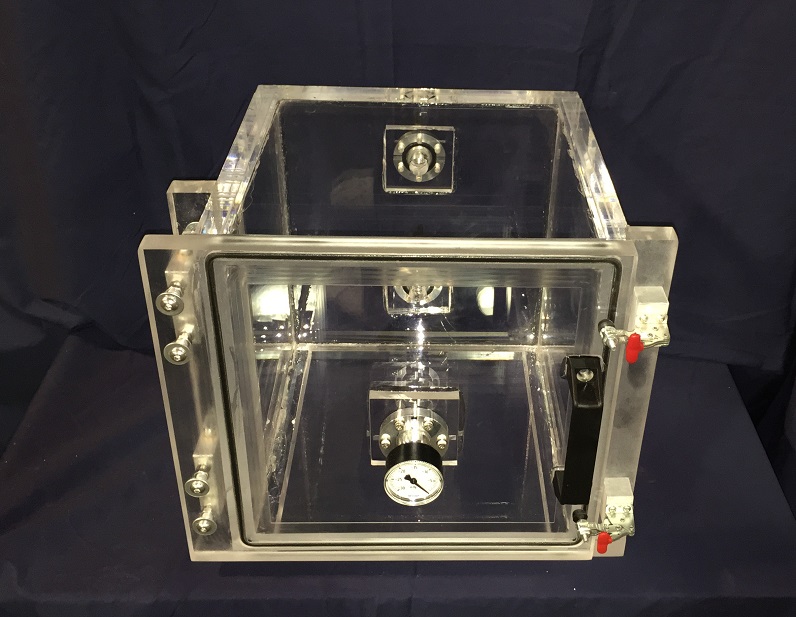
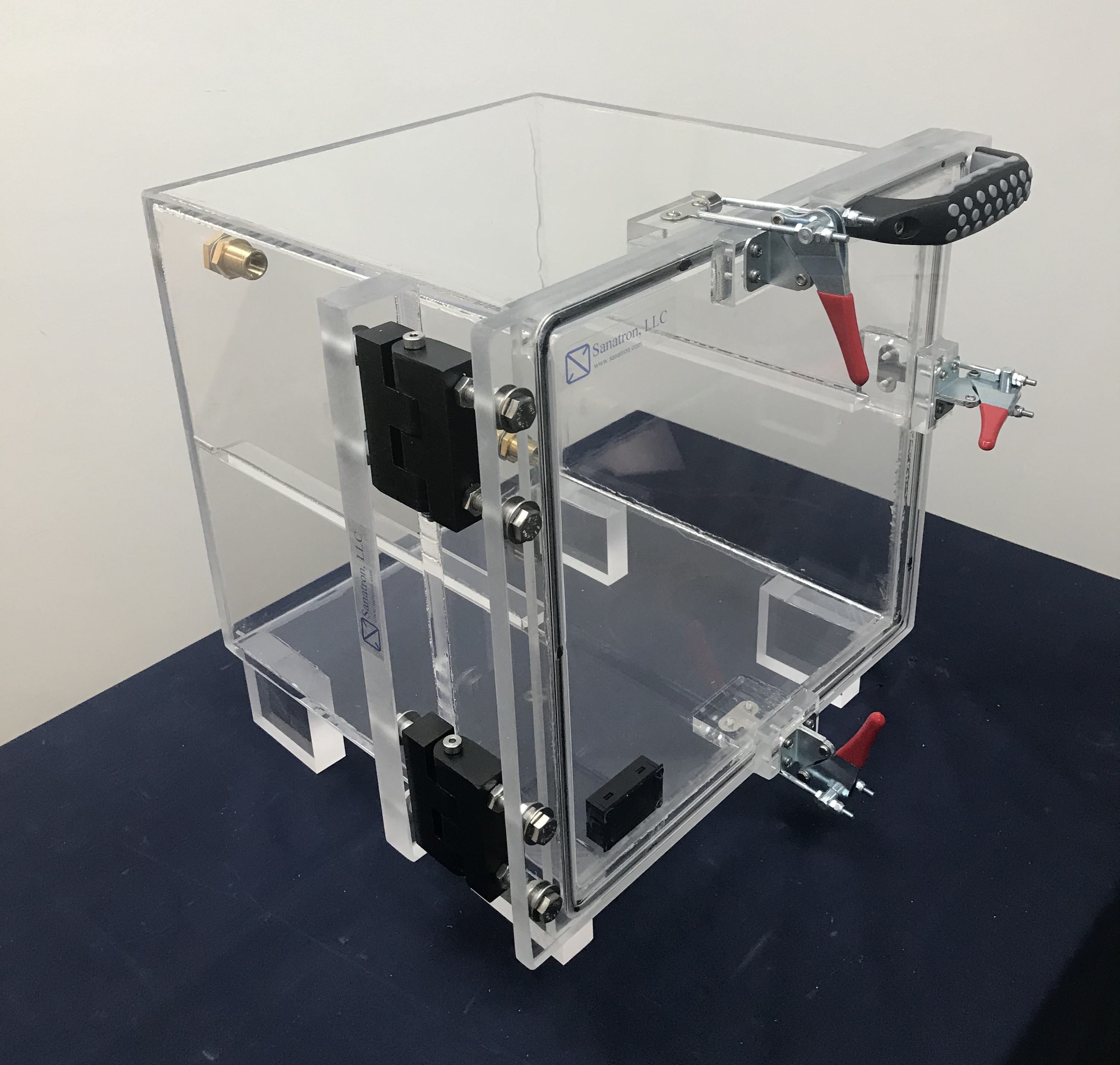
Figure 1. A clear acrylic desiccator cabinet: an airtight dry box with a gasketed door, cam clamps, a digital hygrometer, and plugged gas ports for a dry-air or nitrogen supply.
A desiccator cabinet is a box that does two jobs well. First, it keeps the outside world out: the door seats on a compression seal, a Buna-N O-ring in our desiccator cabinets, and door clamps pull the lid down onto that seal until the enclosure is genuinely airtight. Second, it keeps what is inside dry. That happens one of two ways. The passive method puts a charge of desiccant, usually indicating silica gel, inside the box to grab the water vapor that sneaks in whenever the door opens. The active method uses the built-in 1/4 inch NPT gas ports to bleed in dry house air or nitrogen and hold a dry, mildly positive blanket over the stored parts.
The walls are clear cast acrylic, the same material and the same fabrication quality we use on every chamber we build, which means you can see every tray and tape reel inside without breaking the seal. Every door opening is a humidity event; the transparent walls let you inventory your stock without ever venting the box to the room. A digital hygrometer (about 5% RH accuracy) and digital thermometer (about 1% degree Celsius accuracy) are included so the internal conditions are read and recorded, not guessed at.
How Dry Does a Dry Cabinet Need to Be?
For electronics, the answer is defined by the moisture sensitivity level, or MSL, printed on the component's tape-and-reel label. The industry standard behind MSL ratings boils down to a simple idea: the more humidity a package absorbs before reflow, the higher the odds of package popcorn and delamination when it hits the reflow oven peak. Floor life is the clock that starts running the moment the moisture barrier bag is opened, and storing the parts in a dry cabinet at low relative humidity pauses that clock. Here is how the MSL levels map to floor life at 30 degrees C or less:
| MSL Level | Floor Life Outside Dry Storage |
|---|---|
| 1 | Not moisture sensitive at 30C / 85% RH or less |
| 2 | 1 year |
| 2a | 4 weeks |
| 3 | 168 hours |
| 4 | 72 hours |
| 5 | 48 hours |
| 6 | Per specification; bake before use |
The practical target inside the cabinet is single-digit percent relative humidity. At that level the parts effectively stop absorbing moisture, and a batch that sat out over a weekend can be recovered in the box instead of binned. If your desiccant is exhausted and the hygrometer creeps toward 20% RH and stays there, the cabinet is just a plastic drawer with an expensive gauge on it, which is exactly why the readable hygrometer matters as much as the seal.
What Should You Look for When Buying a Desiccator Cabinet?
Dry boxes on the market range from shoebox-thin plastic to full production lineside cabinets. Before you buy, check the list below:
- 1. A true airtight door seal. A gasket that only keeps dust out will never hold single-digit humidity; you want an O-ring that the door compresses against when the clamps are engaged.
- 2. Factory gas ports. Two plugged 1/4 inch NPT ports turn a passive box into an inert or dry-air purge chamber in minutes, without drilling or retrofitting.
- 3. An honest reading of conditions inside. Trust a digital hygrometer with published accuracy, not a dial you have to squint at; the number is your audit trail.
- 4. Removable perforated shelving. Perforations let dry air circulate around every tray instead of channeling around a solid wall of parts.
- 5. A footprint that fits the work. Single-door boxes start at a 12 inch cube and stack into multi-door cabinets up to 24 inch wide, 24 inch deep, and 36 inch high, so receiving, the SMT line, and the repair bench can each get their own compartment.
- 6. The right variant for your parts. Standard clear cabinets cover most shops, and a non-ESD acrylic desiccator cabinet is available when static-sensitive devices need a different material handling story.
If you are choosing between models or sizes, the clear acrylic desiccator cabinet lineup lists the standard configurations, each one shipped fully assembled and ready to go.
When Should You Use a Vacuum Chamber Instead of a Dry Cabinet?
A desiccator cabinet and a vacuum chamber both keep your product happy, but they are not interchangeable. A dry cabinet is a storage tool: everything inside sits at normal room pressure, and the goal is simply to keep water vapor away from the parts. A vacuum chamber is a test and process tool: a pump actively removes the air so the work experiences an environment far below atmospheric pressure. If your real problem is proving a package has no leak, that is a vacuum bubble leak test. If you need to know what a part does at 40,000 feet, you need real reduced pressure, which means a chamber, not a dry box.
The materials story is also different. Acrylic is mildly permeable and it outgasses, which is perfectly acceptable when you are storing components at one atmosphere, and it is exactly why acrylic chambers are low-to-medium vacuum devices rather than high-vacuum devices, as we cover in our article on the vacuum levels of acrylic vacuum chambers. For storage duty, permeation barely matters because there is no pressure differential to drive the fight; the seal and the desiccant simply keep moisture out. See also the clear acrylic vacuum chamber review for what a pumped chamber does and does not do.
Get a Custom Desiccator Cabinet from Sanatron
Sanatron has been designing and building vacuum chambers, leak testing systems, and custom acrylic enclosures since 2008, and our desiccator cabinets are built with the same cutting, gluing, and sealing discipline as every chamber we make. That means airtight doors, plugged gas ports, digital humidity and temperature readouts, and boxes that can be stacked into monitored multi-door systems sized to your floor space and your part count. Tell us what you need to keep dry, how many trays you need to hold, and whether you want passive desiccant duty or a dry gas purge, and we will build the box around it. Contact Us and talk to a real engineer about your dry storage application.
Frequently Asked Questions
What is a desiccator cabinet used for?
A desiccator cabinet is a sealed dry box used to store moisture-sensitive items such as moisture sensitivity level (MSL) rated electronic components, optics, powders, resins, and reagents. An airtight door with an O-ring seal and a desiccant charge or dry gas supply keep the interior humidity low and stable while the parts sit at normal room pressure.
How is a desiccator cabinet different from a vacuum chamber?
A desiccator cabinet stores parts in a dry atmosphere at normal room pressure; it simply keeps humidity out. A vacuum chamber is actively pumped down to a pressure far below atmosphere, which is what you need for leak testing, altitude simulation, and degassing. Dry storage and vacuum testing solve different problems.
How low can the humidity inside a dry cabinet get?
With a properly charged desiccant or a dry nitrogen purge, a well-sealed cabinet will sit in the single-digit percent relative humidity range, which is the zone most moisture-sensitive-device handling standards call for. A quality digital hygrometer is what proves it, and the hygrometers we supply read to within about 5% RH.
Does a desiccator cabinet need to be plugged in?
No. The cabinet itself is fully passive: the airtight shell, O-ring seal, and clamps do the work, and a desiccant cartridge or a plant dry-air line does the drying. The only powered items are the battery-powered digital hygrometer and thermometer that display the internal conditions.
Can a desiccator cabinet be customized with ports and shelves?
Yes. Our cabinets ship ready to use with a removable perforated shelf and two plugged 1/4 inch NPT gas ports so you can bleed in dry air or inert gas, and they can be ordered as single boxes or stacked multi-door systems. Standard sizes run from a 12 inch cube up to 24 inch wide, 24 inch deep, and 36 inch high multi-door cabinets.
Related Articles:
■ Clear Acrylic Vac Chamber Review
■ Vacuum Levels of Acrylic Vacuum Chambers
Some of our Popular Items
We treat our customers well by Over-Delivering on our Promises (reason why we are Highly Rated on Google My Business). There is a tremendous amount of valuable resources and information regarding vacuum systems and vacuum technology; check them out by clicking on the links below.