Table of Contents
Pressure is one of the defining parameters of any vacuum system, and there are as many ways to measure it as there are pressures, from atmosphere all the way down to ultrahigh vacuum. Here is the pattern: the lower the pressure your process requires, the more critical the measurement becomes, and the fewer your choices of technique and instrument. Once you push below roughly 10-3 torr, the field narrows to two families of instruments: ionization gauges, which give you a single total number, and residual gas analyzers, which sort the gas by species. This article explains what a residual gas analyzer is, how it turns ions into information, and how to decide whether your system needs one.
What Is a Residual Gas Analyzer?
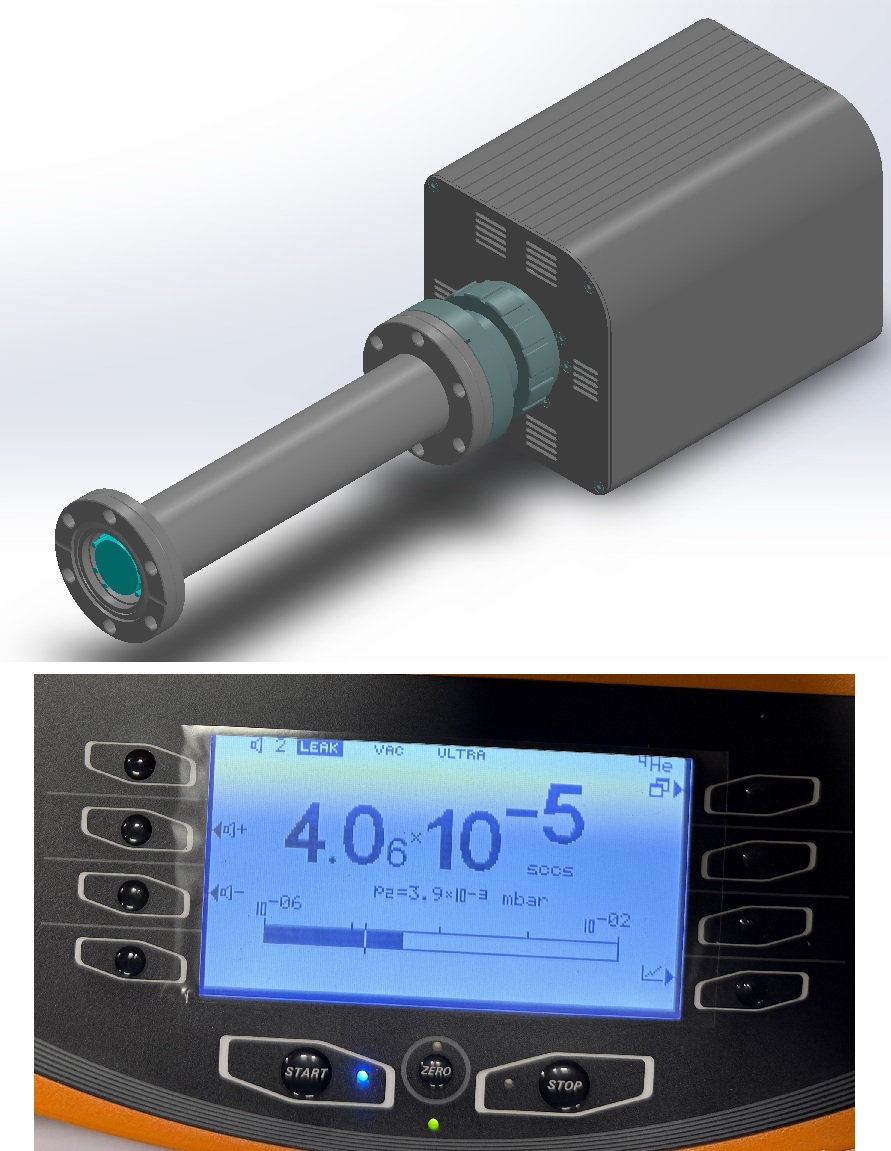
A residual gas analyzer, or RGA, is a mass spectrometer built for vacuum service. It samples the gas already inside your chamber, ionizes the molecules, and then sorts the resulting ions by mass before counting them. The practical result: instead of one combined pressure number, you see the gas population broken apart, species by species.
You will often hear that an ion gauge measures total pressure while an RGA measures partial pressures. That shorthand is useful, but it hides a trap. The residual gas in a real system is almost never a single gas, so any total is really a sum of contributions from whatever mixture happens to be present, and every reading you take is fundamentally an ion current that has been scaled by a sensitivity factor. The number on the display is a derived value, not a direct measurement. Knowing what the instrument is actually doing is what keeps that number honest. If you are new to pressure measurement at all, our guide on how to measure vacuum from atmosphere to high vacuum covers the full gauge family first.
How Does a Residual Gas Analyzer Actually Work?
Both ionization gauges and RGA sensors start the same way. A source of electrons, sufficient in current and energy, strikes the neutral gas molecules in the chamber and knocks electrons loose, leaving positively charged ions behind. A hot cathode tube produces electrons from a hot filament of refractory metal, usually tungsten or thoria-coated iridium; a cold cathode tube traps electrons in a magnetic field instead. Those ions fly to a collector, and the tiny dc current they release when they give up their charge is measured. That current is proportional to the number of ions formed, which is proportional to the number of gas molecules present.
Inside an RGA, one extra stage separates the ions by mass before they are collected. Quadrupole mass filters are the most common design: a set of charged rods acts as a mass-to-charge sieve, passing only the ions of interest to the collector at any moment while rejecting the rest, so the readout sweeps across the mass range and builds a spectrum one peak at a time.
Two physics details decide what you can trust from the spectrum:
- 1. Every gas ionizes with a different efficiency, called its ionization cross-section. Normalized to nitrogen at 1.00, helium sits near 0.14 while methane sits near 1.57, so equal amounts of different gases produce very different ion currents. Diatomic molecules such as nitrogen, oxygen, and hydrogen can also break their molecular bond and appear as both molecular and atomic ions, and gases can even be doubly ionized, further changing the collected current.
- 2. Complex molecules fragment. Methane, a common residual gas, breaks into a family of related peaks rather than one line, and long-chain molecules such as solvents and pump oils produce whole groups of fragments that are specific to that substance. These fragmentation patterns act like fingerprints, which is exactly how an RGA tells one contaminant from another.
The mass filter itself also adds a small error, because ion transmission varies slightly with mass as ions are sorted. And remember the display is showing peaks of ion current indexed by mass number, not true partial pressures in the strict thermodynamic sense. Treated as the comparison tool it is, the RGA becomes one of the most diagnostic instruments in your lab.
Ion Gauge or Residual Gas Analyzer: Which One Does Your System Need?
An ion gauge gives you one number. Because ionization efficiency depends on gas identity, that one number cannot tell you what you are made of: the same reading can represent any one of several different gas mixtures. Water vapor content also drifts from day to day and season to season with lab humidity, so a batch system may take longer to pump down in humid summer air than in dry winter air even though the gauge tells the same story at the endpoint. If a process deliberately admits a process gas as the dominant species, correction factors exist, and if contaminants are minor a fairly true reading can be recovered. But the rule of thumb is blunt: you cannot believe an ion gauge reading without calibration.
An RGA earns its place when gas identity matters, and it generally serves one of two roles:
- 1. System and process monitor. Comparing peak heights at the same mass from day to day or run to run gives early warning that a contaminant is building up, before it becomes a failed batch. The residual gas analysis itself becomes a quality trend.
- 2. Selective leak detector. Air peaks that should not exist show you the envelope is breached before the process even starts; the instrument can then be tuned to lock onto a probe gas like helium and used as a sniffer to find and locate the leak.
- 3. True measurement device. With a proper calibration, the spectrum can be converted into genuine partial pressure readings rather than relative peaks.
In practice the answer to the either-or question is usually both. RGA instruments do provide a total-pressure style readout, but it should be treated as a rough indicator and nothing more, and their rich output can overwhelm an operator who only needed a pressure number. Decide what the application actually requires before choosing. For more background on how tracer-gas leak detection works end to end, see our article on helium leak testing and the tracer gas method, and for the difference between real and apparent gas loads, read about virtual leaks in vacuum systems.
Calibrating Your Residual Gas Analyzer
Because both instrument types carry the same ionization-efficiency error, and the RGA adds mass discrimination on top, calibration is what separates a guess from a measurement. How often you calibrate depends on how much you rely on the reading. For relative monitoring, where you compare today's spectrum to yesterday's, occasional verification is usually enough. If you use the instrument as a true quantitative device, daily or better calibration is often required.
The most practical technique on a continuing basis is a calibrated leak: a reference device that admits a known flow of a single gas or a known mixture into the system for the instrument to measure, and calibrated leaks can be purchased and installed permanently. For an RGA, a known standard mixture that covers the common residual gases across the instrument's whole mass range is the best choice, because it checks both the ionization stage and the mass filter at once. That traceable reference is the same concept we cover in understanding leaks and leak rates: a reading is only as trustworthy as the standard behind it.
Getting Your Vacuum System Diagnostics Right
Choosing between a total-pressure gauge and a residual gas analyzer is really a conversation about your application: what you measure, how precisely you must know it, and how fast you need to see contamination creep or a leak appear. At Sanatron we have been designing and building custom vacuum chambers, vacuum controllers and instrumentation, and complete turnkey leak testing systems since 2008, and we can help you match the right measurement package to the chamber and pump system that fits your process. Contact Us today and talk to a real engineer about your application.
Frequently Asked Questions
What is a residual gas analyzer?
A residual gas analyzer is a vacuum mass spectrometer. It ionizes the gas molecules inside your chamber, sorts the resulting ions by mass with a quadrupole filter, and reports ion current at each mass so you can identify which gases are in the system and how their contributions change over time.
What is the difference between an RGA and an ion gauge?
An ion gauge collects every positive ion on one electrode and displays one total number, so a single reading can hide several completely different gas mixtures. A residual gas analyzer adds a mass filter between ionization and collection, separating the ions so you can see each gas species individually instead of a single combined signal.
Can a residual gas analyzer be used to find leaks?
Yes. Air peaks that should not be there reveal an air leak before you even start the process, and the RGA can then be tuned to lock onto a probe gas such as helium. The instrument acts as a highly sensitive, selective detector as you sweep a helium source along the vacuum envelope, which pinpoints the leak location.
How often should a residual gas analyzer be calibrated?
It depends on how much you rely on the numbers. For relative monitoring, occasional checks are usually enough. If you use the instrument for true quantitative partial-pressure readings, daily or better calibration is often required, most commonly with a calibrated leak that feeds a known gas or gas mixture into the system.
Do I need an RGA or an ion gauge on my vacuum system?
There is no single answer; it depends on your application. If you only need a total-pressure number and can accept gas-type error, a well-calibrated ion gauge may be enough. If you must know which gases are present, or want selective leak detection, you need an RGA. In many systems both instruments are installed and used together.
Related Articles:
■ Vacuum Gauges: How to Measure Vacuum From Atmosphere to High Vacuum
■ Helium Leak Testing: The Tracer Gas Method Explained
■ Virtual Leaks in Vacuum Systems: Causes, Detection, and Solutions
Similar Items
We are an Engineering Excellence Company. You should check out some of our other items we carry; click on the links below.