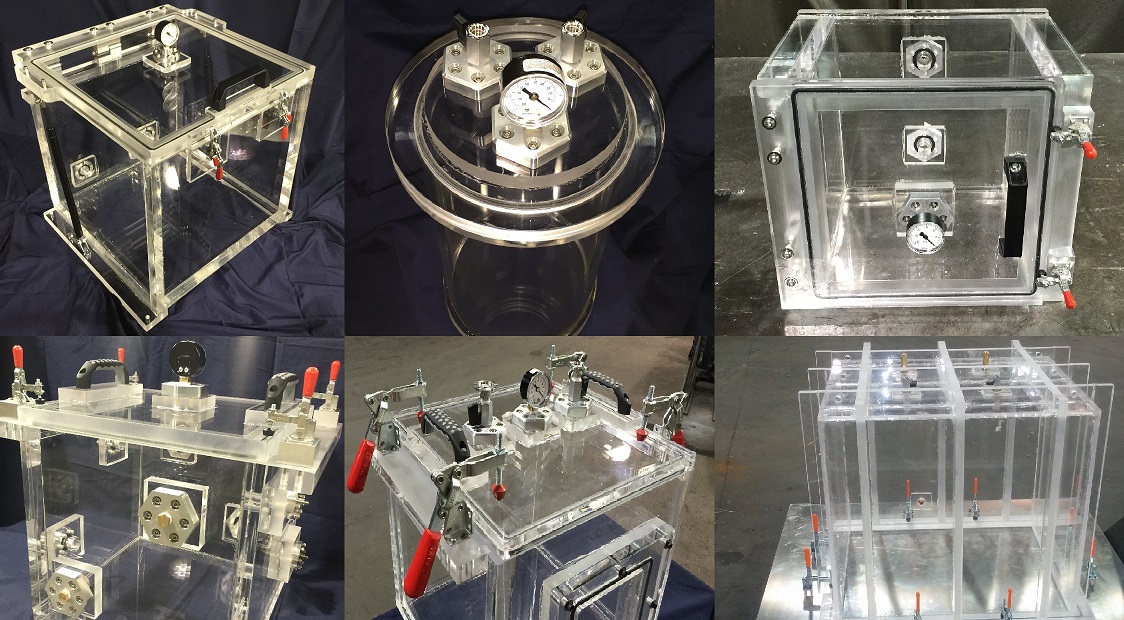
Double Door Vacuum Chamber Square and Cylinder

The size of the square vacuum chamber is 20 inch Wide, 20 inch Deep, and 20 inch High. As a standard every chamber of ours comes with a vacuum valve, a venting valve, and a vacuum gauge. Furthermore, each door comes with a door handle making it easier to pull the door open. Each Door also comes with two clamps which are utilized to create the initial o-ring compression before the vacuum is pulled. As the vacuum takes hold, the door clamps are not necessary as the pressure differential between the outside of the chamber and the vacuum in the inside of the chamber will press the door, and hence compress the o-ring ensuring proper vacuum seal. The size of the cylindrical vacuum chamber is 24 inch Inside Diameter and about 50 inch Length. The cylindrical vacuum chamber does have a few Conflat ports on each lid. The cylindrical vacuum chamber also has an NW25 Vacuum valve.
How large can double door vacuum chambers be? Here at Sanatron theoretically we can make them as long as you would like them. The only constrain we have is that the Width and the Height of the chamber are 24 inch inside Dimensions for the cylindrical chamber and 24 inch Wide by 24 inch High for the square chamber. If the chamber you are requesting starts to become too large, say more than 48 inches in Depth, we will make the vacuum chamber in multiple sections. For example, if the chamber is 9 feet long, we will most likely make QTY:3 x 3 ft deep chambers and connect them making one giant chamber. The reason we would need to create a larger chamber in section is because the raw acrylic comes in 4ft by 8ft sheets and we start running into the sheet limit. Another limitation we may run into leading us to section the chamber is that the 24 inch Wide by 24 inch High Chamber requires 2 inch thick acrylic walls and larger acrylic sheets will become hard to lift, rotate, and handle with the equipment we have and we will therefore need to section it to make it easier to work with. Are you looking to make a long vacuum chamber with multiple doors? Contact us to find out how we can help you build one. Contact us
We have many more resources on our website that you should check out
Our clients prefer to work with us because we are Experts in Custom Fabrication (especially Polymer Fabrication). You should check out some of our other items we carry; click on the links below.
Complete List of Articles Related to Acrylic Vacuum Chambers