Electronic Integrity Testing inside Custom Pressure and Vacuum Chamber

Electronic Integrity Testing inside Custom Pressure and Vacuum Chamber
One of our customers who designs and builds Electronic and Electrical Equipment reached out to us because they had a need for a custom acrylic pressure and vacuum chamber. They needed to subject their electrical components to a vacuum or pressure environments in order to test the performance of their electrical equipment.

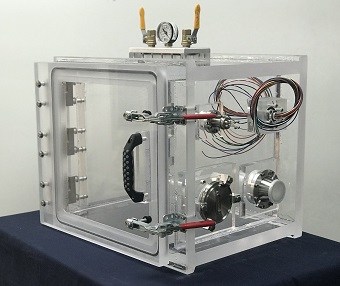
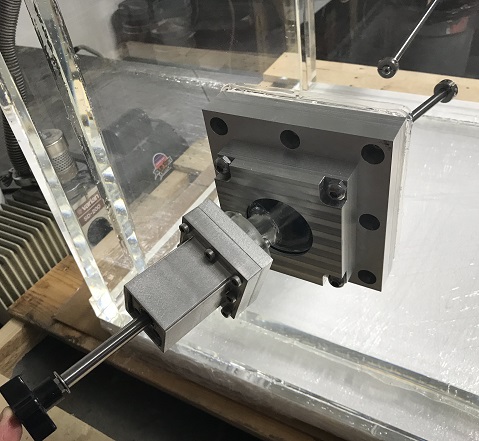
What you are seeing is an acrylic pressure and vacuum chamber. We are looking at the chamber from the right wall. The right wall has a USB vacuum feedthrough and an 8 pin, 5 amp, power feedthrough. The rear wall has an electronic board installed towards the top. The left wall has QTY: 2 x Swagelok Type tube feedthrough, so-called liquid and gas feedthroughs, for a 0.25 inch OD tube. This is intended to be used to run coolant into the chamber during vacuum and pressure operations without compromising the vacuum or pressure operations. The reason there are two liquid and gas feedthroughs is because one tube is used to run the coolant into the chamber while the other is used to run the coolant out of the chamber.

The chamber dimensions are 12 inch Wide, 12 inch Deep, and 18 inch High. There are a total of QTY: 8 Thumb screws which are used to bolt the lid down during pressurization. The lid contains two valves, one dual pressure and vacuum gauge and one safety pressure relief valve that will pop open at 15 psig (the maximum allowable pressure for such chamber. The lid also has two lid handles. You will notice that the bottom wall has interesting design where there are a total of QTY: 8 x slots, 2 on each side. These are used to fasten this whole assembly onto a work table. Are you looking for a pressure or vacuum chamber? Do you need to customize it? Does it need to be robustly designed and quality manufactured to consistently perform and meet your needs? Contact us!

WAIT! Take a look at similar Items you may like…

We make Robustly Designed and Quality Engineered Systems. What are you building? Take a look at the links below and discover some of the cool things we make.
Internal Pressurization ASTM F2096 Leak Testing Systems
Internal Pressurization (ASTM F2096) Leak Testing Systems are instruments that are used during the Quality Control process to discover leaks in sealed packages. As opposed to the vacuum bubble leak test, where the specimen is subjected to a vacuum, the internal pressurization integrity test creates a pressure difference and drives the air through a leak by internally pressurizing the specimen. Our Internal Pressurization Leak Testing Systems are designed and built to conform to the ASTM F2096 Protocol Standard.
Piston Vacuum Pumps
Piston Vacuum Pumps are devices that generate a vacuum through the workings of an internal piston. Several advantages of a piston pump include, low maintenance, no oil mist emission since it’s an oil free vacuum pump – the shortcoming are not as high of vacuum levels and volumetric flow.
Our Work: Altitude Testing in a Vacuum Chamber
It is not a secret that you can simulate a certain altitude in a vacuum chamber. The good thing about Acrylic Vacuum Chambers is not only that you can simulate an altitude of up to 250,000 feet, you can also fully view your test specimen during your testing operation.
Related Articles: Bubble Leak Testing using an Acrylic Vacuum Chamber
Bubble Leak Testing or Bubble Emission Testing is a procedure where leaks are visually detected and located through the emission of bubbles while the test specimen is submerged in water. In this article, we will talk about using an acrylic vacuum box as a leak detection device. We are also going to talk about the advantage, disadvantage, and the bubble leak emission test procedures.