Custom Vacuum System consisting of Multiple Interconnected Vacuum Chambers

Custom Vacuum System consisting of Multiple Interconnected Vacuum Chambers
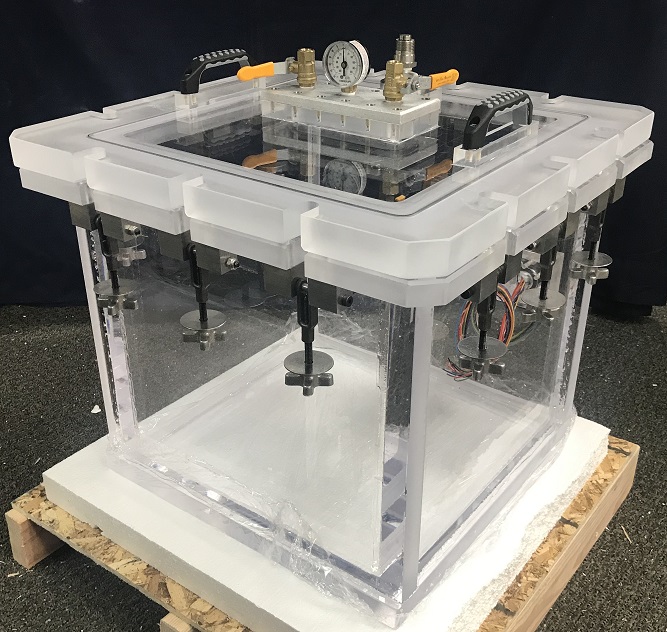
You are looking at a QTY: 2 x Acrylic Vacuum Chambers with inside dimensions of 20 inch Wide, 20 inch Deep, and 20-inch High. Both chambers are connected via a Cylindrical Acrylic Vacuum Chamber, the cylinder is 12 inch Deep and 24-inch High. The cylinder has a 320 ISO port connection on both sides. Making this a complete Multi-Chamber Vacuum System consisting of a total of 3 (three) interconnected and vacuum leak tight chambers.

The two square vacuum chambers are slightly different when it comes to its arrangement of custom ports. The chamber on the left has a total of QTY: 4 x 275 ConFlat Bulkhead Ports, a QTY: 2 x 450 ConFlat Bulkhead Ports, and one 800 Conflat Bulkhead Port. Each Bulkhead port is blaked off with it’s respective blank; square O-Ring included. The Chamber on the right has a total of QTY: 5 x 275 ConFlat Bulkhead Port and a QTY: 2 x 450 ConFlat Bulkhead Ports. Both Chamber have an Optical Breadboard that is 18 inch Wide by 18 inch Deep anchored to the bottom Wall. Both Chambers also have four lid clamps, two 1/4 inch NPT Valves, One Dial Vacuum Gauge, and Two Lid Handles. The lids are fully removable and so are the ConFlat Blanks on each port present on the sidewall.

If you would like to check out our other work and the cool stuff that we make, check out our work: If you are looking to make a custom vacuum system consisting of Multiple Interconnected Vacuum Chambers, contact us.

You may be interested in some of our other items

Our clients prefer to work with us because we are Experts in Vacuum Science and Technology. You should check out some of our other items we carry; click on the links below.

Vacuum Bubble Emission ASTM 3078 Leak Testing Systems
Bubble Emission (ASTM 3078) Leak Testing Systems are instruments that are used during the Quality Control process discover and locate leaks or seal integrity failures. Leaks are detected by submerging the specimen into a tank of water, applying a vacuum, and inspecting the submersed specimen for bubble emission. Our Bubble Leak Testing Systems are designed and built to conform to the ASTM D3078 protocol standard.
Piston Vacuum Pumps
Piston Vacuum Pumps are devices that generate a vacuum through the workings of an internal piston. Several advantages of a piston pump include, low maintenance, no oil mist emission since it’s an oil free vacuum pump – the shortcoming are not as high of vacuum levels and volumetric flow.
Our Work: Research, Development, and Testing of Weather Balloons inside a Clear Vacuum Chamber
A wonderful company (more like one of the best companies in the world) which is currently involved with the research, development, and testing of high-altitude weather balloons, had a need for a vacuum chamber capable of achieving about 100 micro Torr (Micron) of ultimate Pressure for their testing environment. Fortunately, acrylic vacuum chambers are the perfect choice when it comes to Low, Rough, and Medium Vacuum.
Related Articles: Rotary Vane Vacuum Pumps, The Definitive Guide
In the article we are going to cover rotary vane vacuum pumps. We will touch upon how they work, what they are used for, when to utilize a rotary vane vacuum pump, its advantages and disadvantages. Perhaps you have noticed that rotary vane vacuum pumps come in all shapes and sizes. On one website, the vacuum pump is less than a $100; on another website you see a vacuum pump quotes at $10,000. I would imagine that you immediately ask yourself what the deal here is.