Vacuum Encapsulation of Aerospace Devices using Sanatron Equipment

Vacuum Encapsulation of Aerospace Devices using Sanatron Equipment
Vacuum Encapsulation is a process of encasing items by utilizing a vacuum chamber. There are several reasons why encapsulation may be necessary, however they all boil down to protecting the original product thru sheathing or coating.

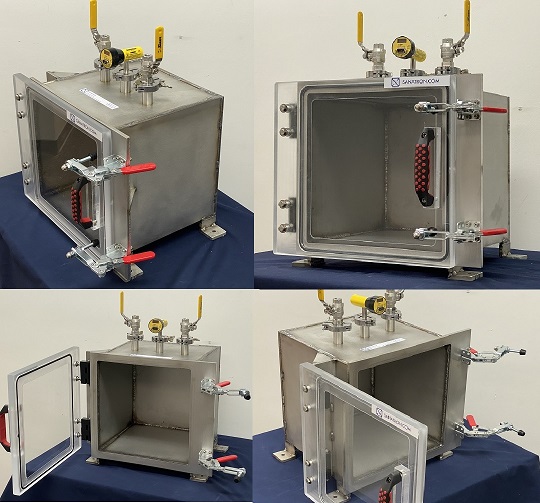
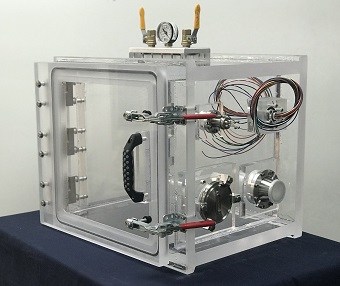
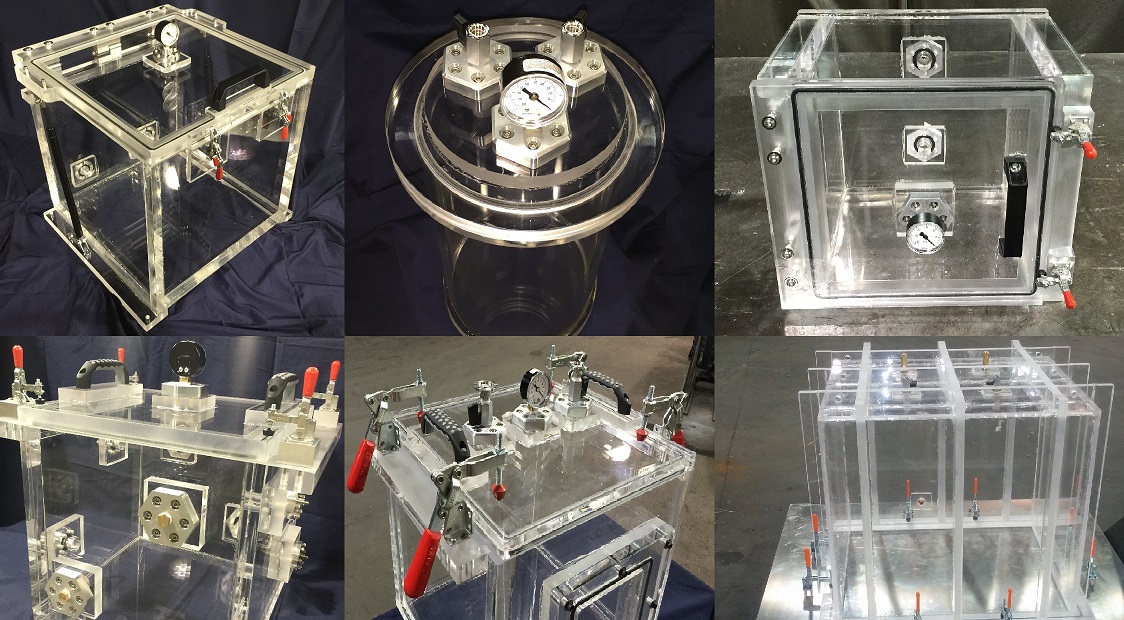
An aerospace customer of ours needed to build a vacuum encapsulation system for one of their product lines. This system included a vacuum chamber, a vacuum controller, a vacuum pump, a custom adjustable jig (placed inside the vacuum chamber), and several feedthroughs for wires and liquid gas feedthrough. The vacuum chamber was 18 inch Wide, 18 inch Deep, and 18 inch High with front loading hinged door. The vacuum pump which came with the system was a 11 CFM, Rotary Vane Vacuum Pump capable of reaching ultimate vacuum of up to 0.010 Torr or 10 milliTorr absolute pressure.

The vacuum encapsulation process works by placing the product onto the adjustable jig. Pulling the target vacuum of 0.475 Torr or 475 milliTorr. Holding it there for about 20 seconds. After 20 seconds have elapsed, the product is ready for vacuum potting. A nozzle will be rotated and placed directly above the product, the potting valve opens, and potting epoxy is dispensed onto the product fully covering it. Once the required amount of potting epoxy has been dispensed, the venting valve will open and the product will be brought to ambient pressures. Due to vacuum being present when the potting compound was dispensed, any gaps will be filled due to the fact that the vacuum is present inside the gap and ambient pressure present outside of the potting compound. If you are looking for a vacuum potting or encapsulation system, look no further, we have a wide variety of Vacuum Encapsulation systems which can be either manual or fully automated for a fully repeatable quality process. Contact us to find out how we can help you design, build, and deliver a quality built vacuum encapsulation system.

Did you know that we carry a many more products?

Our clients prefer to work with us because we are Experts in Vacuum Science and Technology. What are you building? Take a look at the links below and discover some of the cool things we make.

Altitude Simulation Systems
Altitude simulation systems are devices that simulate a certain altitude equivalent by controlling the vacuum inside a vacuum chamber. Altitude is a function of absolute pressure, therefore if a certain pressure is accomplished inside a vacuum chamber, a specific altitude can be simulated from the set pressure. Altitude simulation systems can be configured to not only hold a certain pressure, a complete pressure vs time profile can be programmed to be run. Furthermore, pressure vs time recipes can be loaded and run based on test requirements.
USB Vacuum Feedthroughs
USB Vacuum Feedthroughs are 2.0 USB ports which enable you to run a USB signal into the vacuum chamber during vacuum and pump-down operations. You have several options on what type and size of USB ports you are looking to add to a vacuum chamber.
Our Work: Bubble Leak Testing System with a Dry off Sink used for Leak Testing Large Bags
How do you leak test Large Food Bags? This is the same question a Large Food and Beverage Processor had asked themselves because they had need for a bubble leak testing system which could be used to detect presence of leaks in their large bags. Their requirements were to test several sized bags with the largest bag being 24 inches Wide by 12 inch Deep by 9 inches High. In addition to the bubble leak testing system, they also needed a way to dry the bags after the test.
Related Articles: Force Decay Leak Testing
Force Decay Leak Testing is a very popular quantitative leak testing method used to quality test package and product integrity due to its ability to detect small leaks which cannot be seen through visual inspection. In this method, the test specimen is internally inflated by either internal pressurization or vacuum force. The inflated test specimen will, in turn, apply a force on a pressure transducer. Finally, the change in force applied by the inflated specimen over a specified time is observed.