Vacuum Testing of Aerospace Equipment implementing Custom Chambers

Vacuum Testing of Aerospace Equipment implementing Custom Chambers
A large aerospace company and a DoD contractor requested a quote from us for a custom vacuum tester to be utilized for the vacuum testing of various Aerospace Equipment Parts on their production line. All of their items were solid and ridged containers, cubic, square, and cylindrical which needed to be tested by following the vacuum submersion testing technique.

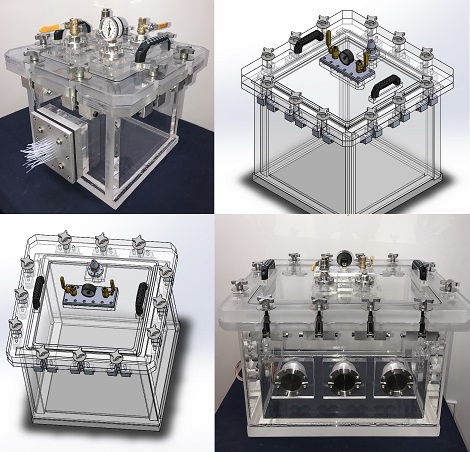
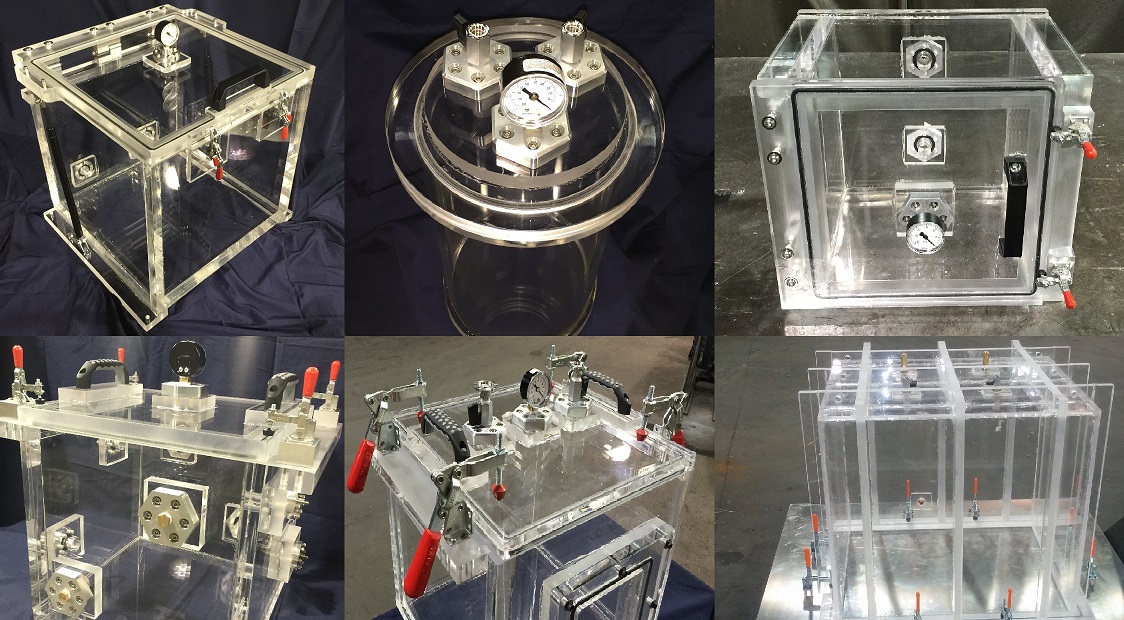
With that said, this test does require an extra step in that the part must be under vacuum when it is above the water level. As soon as the target vacuum is reached, the part is dunked under water. Once the test is completed, the part is lifted above the water level one more time before the chamber is vented. The solution we provided was to modify our standard Vacuum Bubble Leak Tester to accommodate all our client’s requests. The vacuum chamber is about 12-inch Wide, 10-inch Deep, and about 8-inch High. The vacuum is generated by a standard duty, rotary vane vacuum pump. The rotary vane vacuum pump comes with an oil mist eliminator, exhaust filter that will minimize or prevent from oil mist being exhausted into it’s surroundings. Furthermore, the rotary vane vacuum pump also comes with a vacuum pump protection valve which will close off if water is present in the vacuum line.

The chamber is top loading with a hinged lid. On the lid is the vacuum gauge, the venting valve, and the vacuum valve. Inside the chamber is a plate that can be lifted either upwards or downwards, depending if the testing sample is needed to be above the water line or below the water level. The specimen plate is lifted via the two levers which are connected to the front wall. A vacuum rotary feedthrough will translate rotary power from the outside of the chamber to the inside of the chamber without compromising vacuum during operations. The levers can either swing inwards and lower the tray or swing outwards and lift the tray. We also have a fully automated pneumatic version that does not use levers by four pneumatic cylinders to drive the tray upwards or downwards. If you are looking for a vacuum dunk test which requires some complex procedures, feel free to reach out to us to discover how we can assist you with you leak testing needs.

We have many more resources on our website that you should check out

We treat our customers well by Over-Delivering on our Promises (reason why we are Highly Rated on Google My Business). Check out some of our other items we carry that you can combine/integrate with your systems or projects.

Helium Leak Testing Systems
Helium Leak Testing Systems are instruments which detect leaks in specimen by detecting present of helium. Helium is used as a tracer gas to detect and quantify a leak. For example, a test specimen is filled with helium and placed into a test chamber, a vacuum is pulled and a helium mass spectrometer is connected to the test chamber. If helium is detected, it is due to the fact that it has escaped from the specimen through a leak path. Helium Leak Testing is a qualitative and quantitative method of detecting product leaks.
Piston Vacuum Pumps
Piston Vacuum Pumps are devices that generate a vacuum through the workings of an internal piston. Several advantages of a piston pump include, low maintenance, no oil mist emission since it’s an oil free vacuum pump – the shortcoming are not as high of vacuum levels and volumetric flow.
Our Work: Chamber for Vacuum Extrusion System
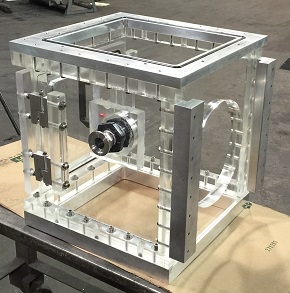
This is a custom acrylic vacuum chamber build for a high volume manufacturer of parts which are fabricated using vacuum extrusion techniques. The challenge was to build a vacuum chamber system which mated on two perpendicular surfaces; on the bottom and on the rear of the chamber. This was accomplished by incorporating a double gasket mechanism on the bottom and incorporating a clamping mechanism on the rear.
Related Articles: In Process Seal Integrity Testing of Food Bars sealed with Flow Wrappers
This article will talk about how to test the seal integrity of food bars. You will understand what you will need to do in order to ensure good seal quality. This article covers the seal integrity testing of Breakfast bars, Chocolate candy bars, Crisped rice bars, Energy bars, Granola bars, Health bars, Protein bars, Fruit and Nut Bars, Meal Replacement Bars or any other food bar sealed with a flow wrapper.