Vacuum Panel Plate with Various Vacuum Feedthroughs

Vacuum Panel Plate with Various Vacuum Feedthroughs
Our custom-made vacuum panel plate will come in handy in the future. Let us explain. When our clients are getting a vacuum chamber or a vacuum system from us, they sometimes do not know what vacuum feedthroughs such as Wire, USB, Thermocouple, D-SUB, Ethernet, Liquid and Gas, etc. they may need in the future. A dilemma arises if a vacuum chamber without the vacuum panel plate has been purchased. This means that in order to add vacuum feedthroughs to the vacuum chamber, the actual vacuum chamber will need to be modified. This can be done either by having the customer drill into the chamber, this is not recommended because DIY vacuum chamber modification will create risk of product damage and or personnel injuries. Another option is to either order in house service and or ship the chamber back to manufacturer for modifications. Both will result in downtimes and ore delays.

The best option is to order a vacuum panel plate at the time the actual vacuum chamber is ordered because the vacuum panel plate can be modified or a new panel plate can be made and shipped to the customer without having to modify the actual vacuum chamber or having to send the vacuum chamber back for modifications. Hence saving time and money.

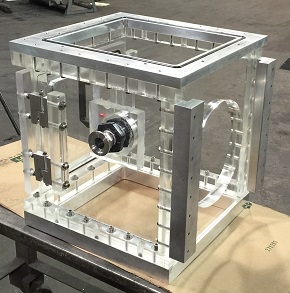
What you are looking at is a vacuum panel plate that we made for our client. A year or so after they purchased a vacuum chamber from us, they requested a couple of feedthroughs to be installed on the vacuum chamber. Fortunately, they had the blank panel plate. What we did is we made them another panel plate and installed the feedthroughs they wanted. They wanted a QTY: 8 BNC Vacuum Feedthroughs, a QTY: 1 x D-SUB 15 pin Vacuum Feedthrough, and QTY: 4 x pair, Type-K thermocouple Vacuum Feedthroughs. Once our customer received the custom plate with the feedthroughs they wanted, they simply removed the blank plate and installed their new plate within minutes. If you are looking to get a vacuum chamber but don’t know what vacuum feedthroughs you will need in the future, contact us to see how we can help you hash things out.

Some of our Popular Items

We make Robustly Designed and Quality Engineered Systems. What are you building? Take a look at the links below and discover some of the cool things we make.

Force Decay Leak Testing Systems
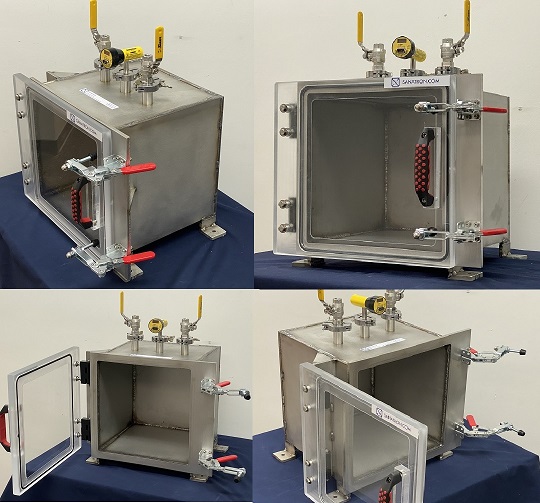
Force Decay Leak Testing Systems are instruments that detect and quantify leaks in a test specimen through measuring the drop in force an inflated specimen applied onto a pressure transducer. The specimen is placed into a vacuum chamber, a vacuum is pulled, and the test sample inflates. As the test sample inflates, it applied a specific force onto the force transducer. This force is measured and recorded over time. If a leak exists, the specimen will deflate and lose pressure, as a result, the force it applies onto the force transducer will decrease. This in turn will enable for detection and quantification of a leak in the specimen.
Viewport Vacuum Feedthroughs
Viewports Vacuum Feedthroughs are windows that enable you to look into the inside of your vacuum chamber. If you are using a metallic vacuum chamber with a metallic lid, you will not be able to view the interior of your vacuum chamber unless you have a viewport. Viewports also enable a different electromagnetic spectrum of light to passthroughs.
Our Work: Custom Vacuum Chamber with Blank Plate
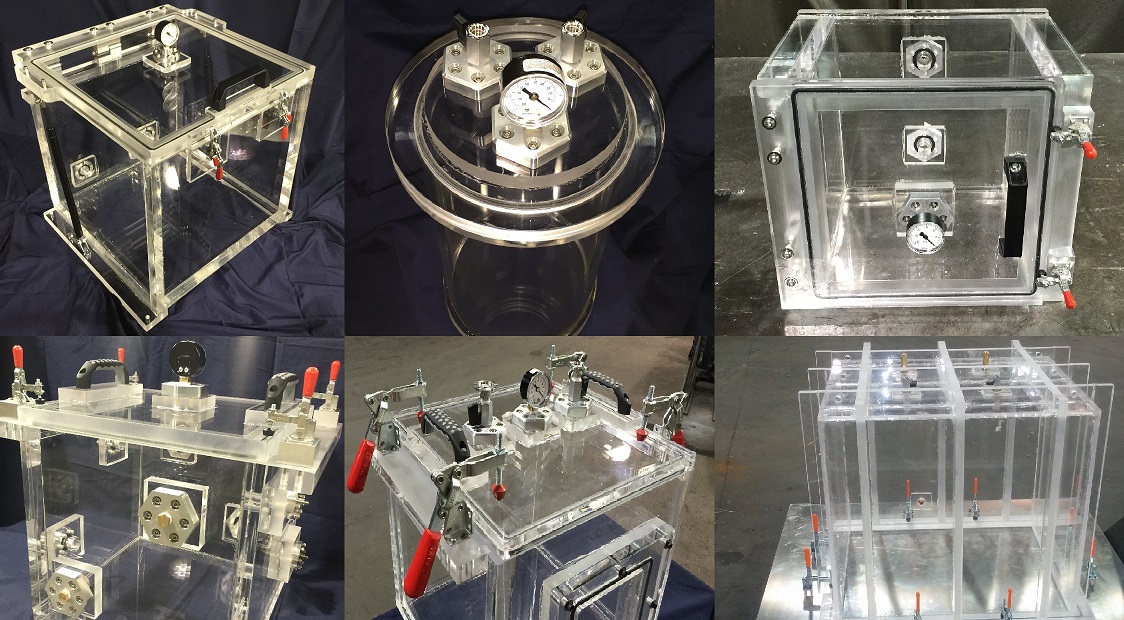
You are looking at our standard Acrylic Vacuum Chamber, Hinged Door with Clamps. There is only one difference; this vacuum chamber has a blank acrylic plate that is connected to and aluminum plate which in turn is anchored to the side wall of the acrylic vacuum chamber. This blank plate is there to enable our client to add vacuum feedthroughs to the side wall in the future
Related Articles: Seal and Package Integrity Testing of Vacuum Sealed Packages
How do you test the seal of vacuum sealed packages? If you are vacuum sealing your packages, you are faced with a challenge when it comes to seal testing. How do you know that your process is consistently creating a good seal? How can you be sure that the vacuum inside you package will hold for the required amount of time?