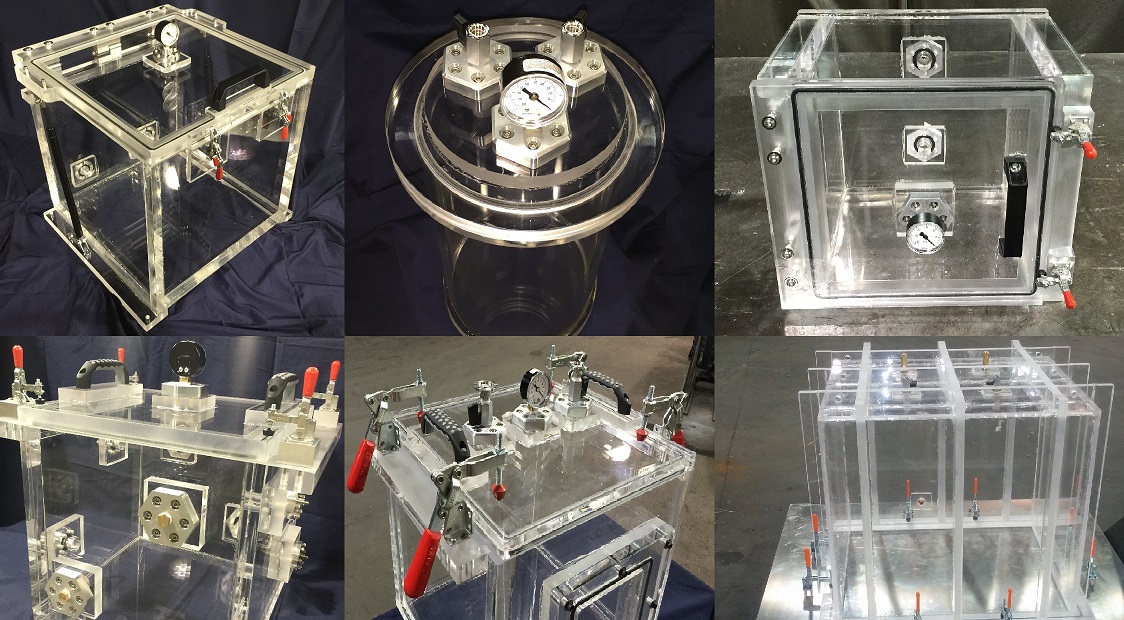
Vacuum Decay Leak Testing of Biotech Devices utilizing an Acrylic Vacuum Chamber

The Vacuum Decay Leak Test is a type of a test where the test specimen is placed into the vacuum chamber, a vacuum is pulled, the vacuum valve is closed, and the change in vacuum (absolute pressure) is observed over time. One of the main advantages of the vacuum decay leak test is that it is a much more sensitive test than the dry vacuum test or the vacuum bubble leak test. Reason being is because a vacuum of 0.5 Torr is pulled and the change in vacuum is observed over 30 seconds, sometimes several minutes. The operator will not be able to see the difference in specimen behavior between a vacuum of 0.5 Torr and a vacuum of 3 Torr. However, the digital vacuum gauge will be able to detect such minor changes and quantity this change into a leak. If the change in vacuum is greater than the setpoint, the Vacuum Decay Test Instrument will detect this and fail the test. A vacuum decay leak test offers an objective test without the reliance on the operator as the test result is either a PASS or a FAIL. A disadvantage of the vacuum decay leak test is that it will not allow the operator to locate the leak; something that the vacuum bubble leak test can easily do via the presence of bubble emission. However, the vacuum decay leak test is much more sensitive than bubble leak test because minor changes in absolute pressure detected. It therefore offers a much better signal to noise ratio. The lowest absolute pressure a vacuum bubble leak test can go to is about 250 Torr, anything beyond that and the water bath will start to degas or boil which results in the creation of bubbles that interfere with the visual detection of bubbles. On the other hand, the vacuum decay leak test can be pulled to a vacuum of 0.250 Torr or beyond, which is one thousand times greater vacuum than can be pulled via the vacuum bubble decay leak test and the reason the leak detection is much more sensitive.
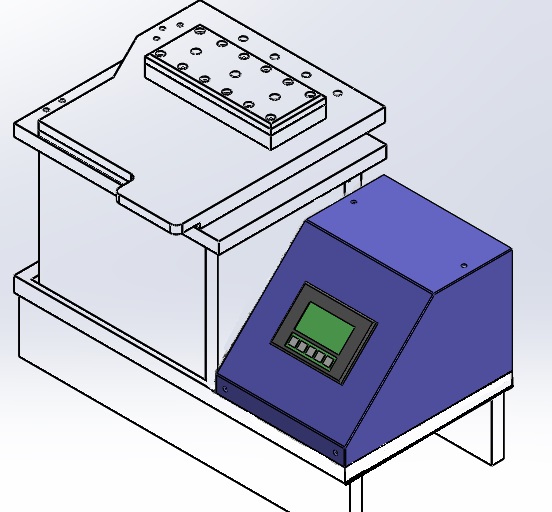
When the need for detecting a small leak is much greater than the need for detecting and locating a gross leak, a Vacuum Decay leak test is the way to go. A 10 inch cube inside dimensions acrylic vacuum chamber was built and coupled with a Vacuum Decay Leak Testing Instrument. Our happy customer would place their test product into the vacuum chamber and simply push the START Button on the Vacuum Decay leak Test Instrument. The Device would pull a vacuum to the specified level, it would close the valve, and observe a change in vacuum over time; 45 seconds in this particular test. If the change in vacuum was below the setpoint, the instrument would output a PASS on the HMI screen. If you are looking for a vacuum decay leak tester to test your products, contact us. We not only offer standard vacuum decay leak detection, we can also make custom devices to accommodate your products.
Similar Items
Our clients prefer to work with us because we are Experts in Custom Fabrication (especially Polymer Fabrication). Check out some of our other items we carry that you can combine/integrate with your systems or projects.

Complete List of Articles Related to Acrylic Vacuum Chambers