Opaque Vacuum Chamber

A customer of ours reached out to us to see if it was possible to design and built a vacuum chamber that is made from polymers but is also opaque. They were testing some light sensitive equipment where it was critical that the amount of light coming in and going out was strictly controlled for. When they reached out to us, we knew that opaque acrylic existed, but we only knew about thinner acrylic panels, those which were about 0.25 inch thick. Acrylic this thin cannot be used for vacuum applications because the forces applied to the wall at 15 psi are large and will risk beveling, bending, and damaging the walls at full vacuum. Imagine a vacuum chamber which that is 10-inch by 10-inch and at 15 psi of vacuum, the force applied to the wall due to pressure differential equals the area times the pressure which is 1500 lbs. That is the weight of a car being applied to a 0.25-inch-thick acrylic panel, barely enough. So we reached out to our supplier to see if they had something thicker, and they did.
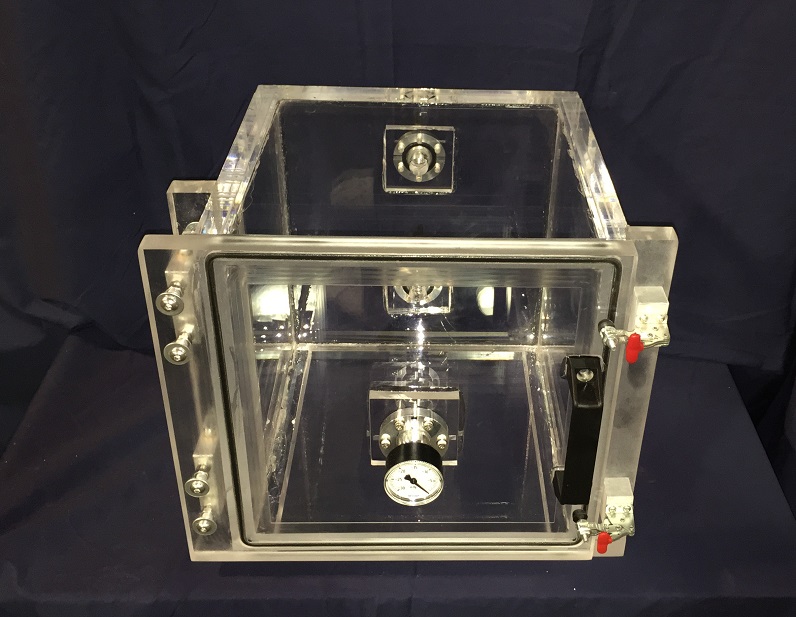
What you are looking at is an opaque acrylic vacuum chamber that is 10 inch Wide, 10 inch High, by 20 inch Deep. This is a hinged door, front loading chamber where the door fully swings open towards the front right allowing for easy chamber loading. The door comes with two hinges, two clamps, and one lid handle. Another customization made to this chamber is a 15 pin D-SUB (subminiature D) Connector on the Left Wall at center. This chamber can be easily placed onto a table top and operated as a bench top unit. Looking for a vacuum chamber? Let us know how we can help you. Contact us.
WAIT! Take a look at similar Items you may like…
Our clients prefer to work with us because we are Experts in Custom Fabrication (especially Polymer Fabrication). There is a tremendous amount of valuable resources and information regarding vacuum systems and vacuum technology; check them out by clicking on the links below.
Complete List of Articles Related to Acrylic Vacuum Chambers