ASTM D6653 Protocol and Procedure Explained

What is the ASTM D6653 Protocol?

ASTM D6653 establishes a standardized vacuum-based methodology for evaluating how packaging systems respond to the pressure differentials encountered during high altitude transportation. Under these scenarios, the reduction in ambient pressure can induce expansion forces within packages that may compromise seals, closures, internal cushioning, or the product itself. Rather than producing strictly quantitative pass or fail metrics, the method is intended to provide qualitative insight into whether a given packaging configuration is robust enough to tolerate altitude induced stress without visible deformation, leakage, or functional degradation. By simulating altitude conditions inside a controlled vacuum chamber environment, the test allows manufacturers and engineers to reproduce worst case transport scenarios in a repeatable and standardized manner before products ever enter the distribution chain.

The scope of ASTM D6653 emphasizes packaging system evaluation as an integrated whole, encompassing the product, primary packaging, secondary packaging, and closure mechanisms as they would appear in actual shipment. The standard references several complementary ASTM methods, including bubble emission testing, rigid container vacuum testing, and gross leak detection, acknowledging that altitude simulation often overlaps with leak integrity concerns.

This, in a quick summary, covers most of it it.
Purchase your copy Today!

ASTM D6653 Step by Step Procedure

Step 1: Conditioning (Not Required)
The Test Specimen are temperature conditioned at 5.6 ± 2 °C (42 ± 3.6 °F) for 24 hours.

NOTE: This step is not necessary as Test Specimen can be tested at room Temperature

Step 2: Sample Placement
The Test Specimen are placed inside a vacuum chamber

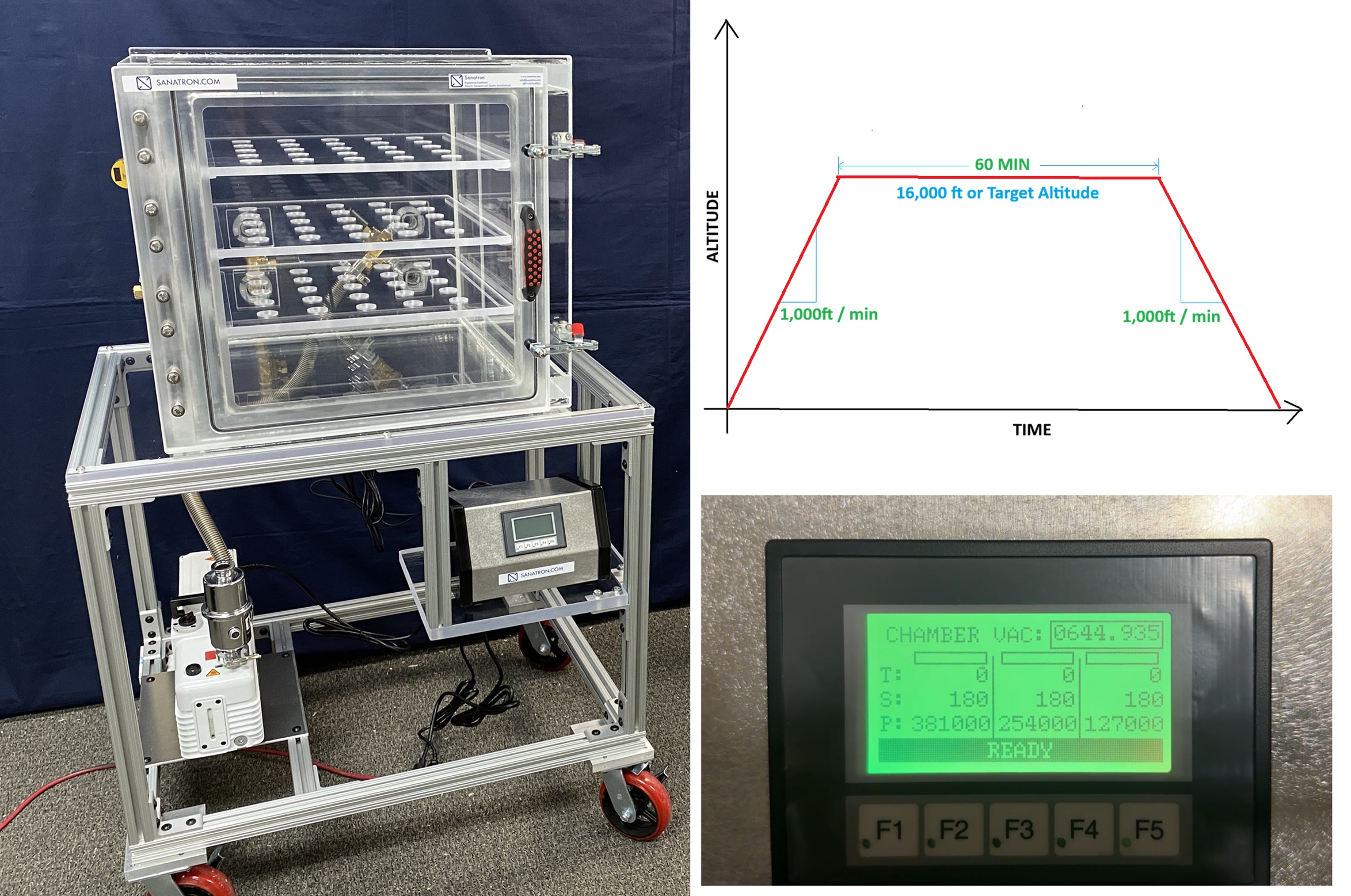
Step 3: Target Altitude / Vacuum
The Test Specimen are subjected to an altitude equivalent of 14,000feet (if unconditioned) or 16,000 feet (4,877 meters) (for Temperature Conditioned) Specimen. The altitude tolerance is +/-5%, meaning you can go anywhere between 13,300 feet to 14,700 feet and 15,200 feet to 16,800 feet.

NOTE 1: The Ascend rate towards the 16,000 feet is prescribed at 1000 feet every 30 to 60 seconds

NOTE 2: The Test Specimen may be subjected to a higher altitude beyond the 16,000 feet. This is not a set-in stone altitude the test specimen must be subjected to.

Step 4: Dwell Time
The Test specimen is held at the Target Altitude for 60 minutes.

Step 5: Venting and Descend
After 60 minute dwell time has completed, the vent valve is opened and the chamber is vented bringing the test specimen to ambient pressures at a rate of 1000 feet every 30 to 60 seconds.

What Equipment do I need in order to perform the ASTM D6653 Test?

Vacuum Chamber
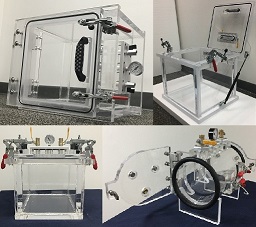
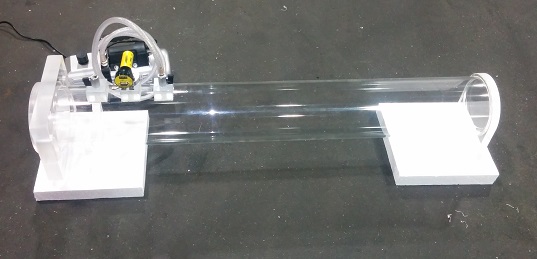
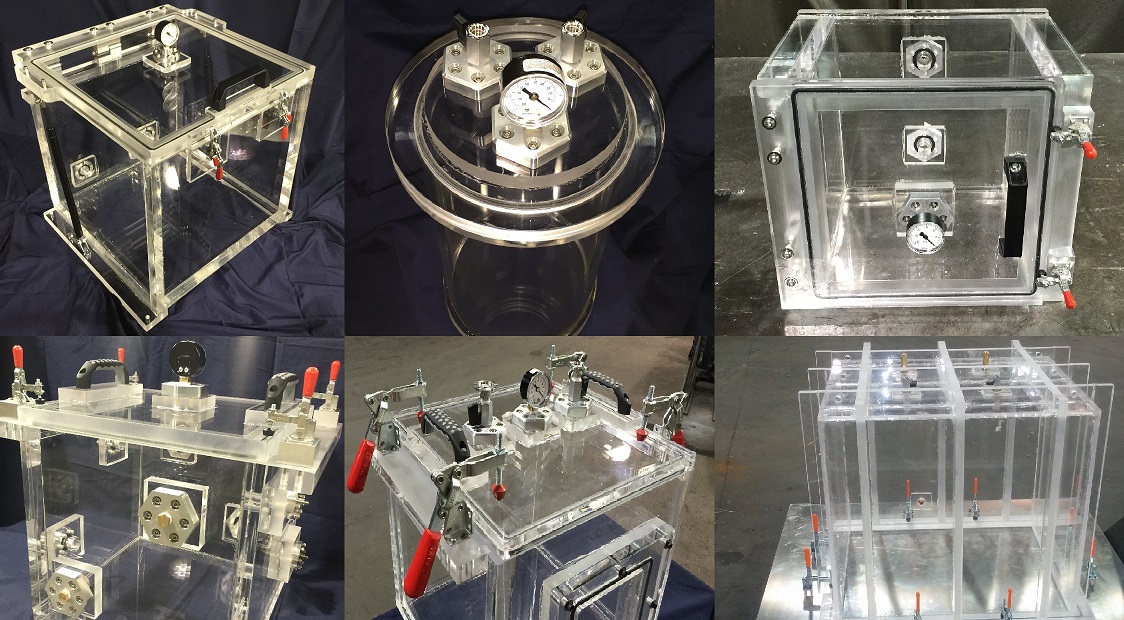
Ideally, you will need a vacuum chamber, preferably acrylic, to allow for full visibility of test specimen during the test run. A stainless-steel chamber may be used if the door is acrylic because it will allow visibility from the front side.

Vacuum Pump
You will need a vacuum pump capable of reaching your target altitudes. A good vacuum pump would be a rotary vane vacuum pump or a piston pump.

Vacuum Controller
The vacuum controller needs to be capable of ascend and descend rates. At minimum needs to be programmable for target altitude and hold time.

Sanatron does offer standard solutions that you can check out here

Some of our Popular Items

We treat our customers well by Over-Delivering on our Promises (reason why we are Highly Rated on Google My Business). You should check out some of our other items we carry; click on the links below.

Altitude Package ASTM D6653 Leak Testing Systems
Altitude Package (ASTM D6653) Leak Testing Systems, or Testing Systems which test the effect of higher altitude on packages are vacuum systems that consist of a vacuum chamber, a vacuum controller, and a vacuum pump. The goal of these package testing systems is intended to test and investigate the effects of higher altitudes on the seal integrity, package quality, or container closure integrity.
BNC Vacuum Feedthroughs
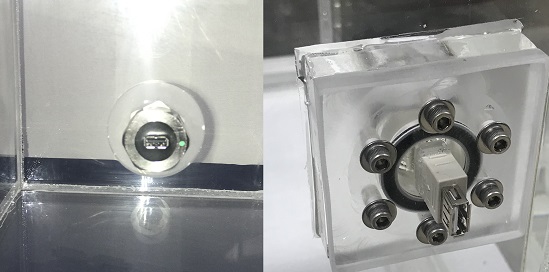
Coaxial Vacuum Feedthroughs are vacuum rated BNC connectors that enable you to run BNC from outside of vacuum chamber towards inside of the vacuum chamber without disturbing the vacuum. Triaxial Vacuum Feedthroughs, just like coax vacuum feedthroughs, will enable you to run Triax Connections from outside towards the inside of the vacuum chamber without disturbing the vacuum levels inside the vacuum chamber.
Our Work: Electronic Component Testing of Satellites at High Altitudes
Electronic Components of Satellites behave differently in outer space as compared to how these behave at sea level. How do you know that your satellite will survive outer space? How do you confirm that your circuit boards will function properly at higher altitudes? There is only one way to find out, and that is to test and validate your design.
Related Articles: Bubble Leak Testing using an Acrylic Vacuum Chamber
Bubble Leak Testing or Bubble Emission Testing is a procedure where leaks are visually detected and located through the emission of bubbles while the test specimen is submerged in water. In this article, we will talk about using an acrylic vacuum box as a leak detection device. We are also going to talk about the advantage, disadvantage, and the bubble leak emission test procedures.